Options School · Episode 11
The Debit Spread: Pay Less for a Call, Cap the Profit
 Play the video · 10:00
Two spreads on the same strikes: one pays us when we enter, we pay for the other. Which of the two is better? On a risk graph, with an example index at 7,800: from a bought call to the spread, selling a call above it to pay less; why, on the same strikes, a credit spread and a debit spread are the same position; where to place the strikes, and what that does to the cost, the payout and the probability; the greeks, with time against us until the price passes the strikes; credit and debit side by side; what it is for, from a directional idea at a small fixed cost to protection and scalping; and the limits.
For information only. Not financial advice or an investment recommendation. Trading involves risk of loss. Risk disclosure ↗︎
Chapters
Transcript
Show the full transcript
The narration of the video, as text.
Here are two spreads with the same two strikes and the same chart. One pays you when you enter. The other one, you pay for. Which of the two is better?
Welcome to the LiveGexLevels options school. Languages are dubbed automatically. This is education, not advice.
Episode eleven, the debit spread.
In the last episode we sold a spread and collected a credit. Today we buy one, on the same chart and the same example index, and we answer the opening question.
We start from a call, like in the second episode. The index is at 7,800, and we think it will rise in the coming weeks.
We could buy the call with the 8,000 strike, forty-five days from expiry. It costs about 99 points, and each day that passes takes a little of them away.
In the second episode the call was the right to buy a flat at a fixed price. Suppose you think the flat's value will rise, but not beyond a certain level. You can sell to someone else whatever comes above that level. That person pays you today, and your right costs you less.
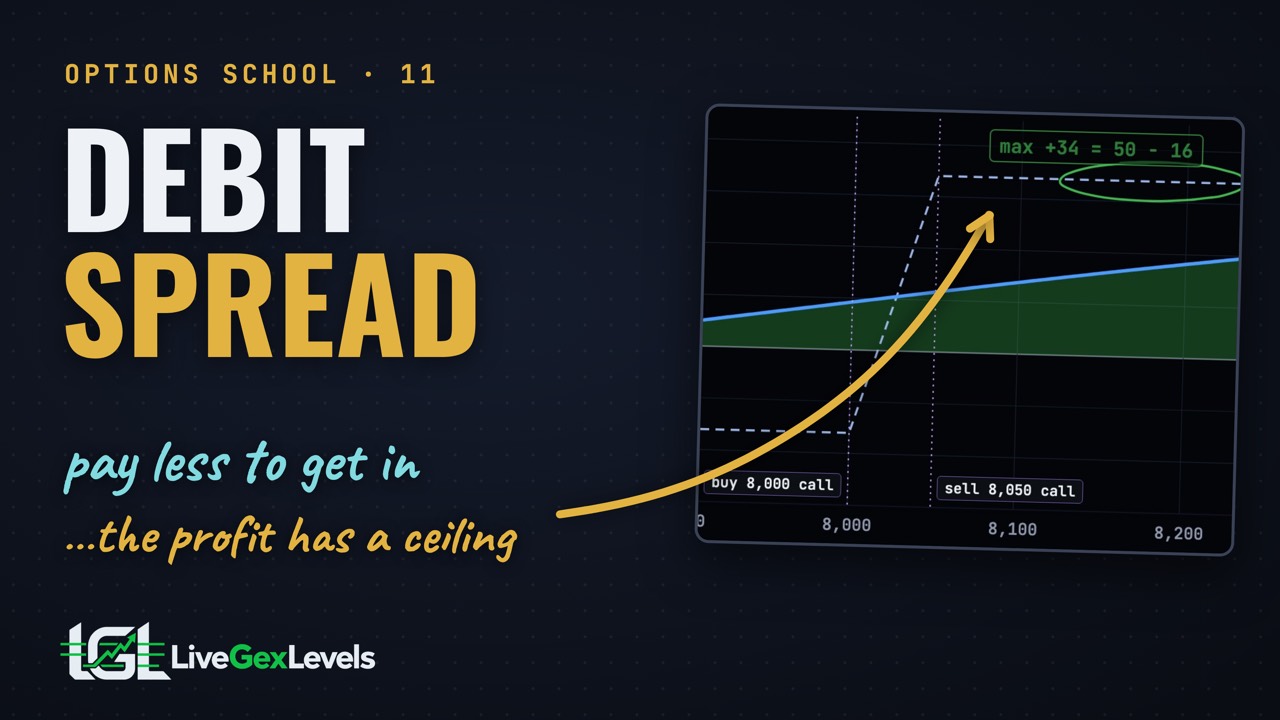
We do the same. We sell the call with the 8,050 strike, and we collect about 83 points. Our cost drops from 99 points to 16.
Now look at the chart. Above 8,050 the line goes flat. The most we can make is the distance between the strikes, 50 points, minus the 16 we paid. That makes 34 points.
We pay to get in, and that's why it's called a debit spread. And the most we can lose is what we paid.
Now the opening question. We put two spreads on the same strikes, 7,550 and 7,600.
The first is last episode's credit spread, made with puts. We collect 13 points and we risk 37.
The second is a debit spread made with calls. We buy the call with the 7,550 strike, we sell the one with the 7,600 strike, and we pay 37 points to make at most 13.
Look at the two charts. They draw the same line, with the same breakeven and the same probability, about 70 percent.
Here's a detail that's rarely said. On the same strikes, a credit spread and a debit spread are the same position. What changes is when the money moves. The first pays you at the start and holds the risk as margin. The second makes you pay the risk up front.
So neither of the two is better. What matters is where you place the strikes compared with the price.
Now we slide the call spread along the chart, and we watch two things, what we pay and the probability.
Below the price, we pay 37 to make 13. The probability is high, about 70 percent.
Around the price it's about one to one, and the probability is about one in two.
Above the price, at 8,000, we pay 16 to make 34. That's about two to one in our favour, but the probability drops to about 30 percent.
The farther we go, the less we pay, and the less often it works. It's the rule of the ninth episode, seen from the buyer's side.
This is what people usually mean by a debit spread. The cost is small and known, the payout is a multiple of the cost, and the probability is lower. The index has to move, and in the right direction.
Now the greeks, on the spread above the price, 8,000 and 8,050.
Here time works against us. With the index still, the spread loses about 12 dollars a day. The call alone would lose about 200.
Volatility helps instead. If it rises, the spread gains a little value, far less than the call alone, because the sold call takes most of it back.
Now look at the theta curve along the chart. It crosses zero near the upper strike. Below the strikes time takes value away, and above them time brings it.
So once the price has gone your way, time starts to work for you. A single bought option never does that, because its theta is negative everywhere.
Vega crosses zero too. Above the strikes, it's a calmer market that helps.
We take the slider toward expiry, with the index still at 7,800. The solid line sinks, and the 16 points wear away. Without a move, a debit spread beyond the price loses what it cost.
Let's put them side by side, each one in its usual place. The credit spread sits away from the price, on the side where the index is not expected to go. The debit spread sits beyond the price, where the index has yet to arrive.
The probability is high for the credit spread and low for the debit spread.
The payout goes the other way. The credit spread risks a lot to make a little, and the debit spread risks a little to make a lot.
Time works for the credit spread and against the debit spread.
A rise in volatility hurts the credit spread a little and helps the debit spread a little.
In one line, the credit spread needs the move not to come. The debit spread needs the move to come, and before expiry.
What is a debit spread for?
The first use is a directional idea at a small, fixed cost. You know from the start the most you can lose.
The second use is protection. In the last episode we said that whoever sells premium has to think about the falls. A debit spread made with puts, placed below the price, costs little and gains value if the index drops.
It has one more thing on its side. When the index falls, volatility usually rises, and at the start of the fall that rise helps the spread too.
The protection has a ceiling, though. Below the lower strike it stops growing.
In scalping, the debit spread is the mirror of the credit spread. The credit spread fits the idea that a level holds, and the debit spread fits the idea that a level breaks. We'll come back to it in the session on scalping trades.
Now the limits.
With the strikes beyond the price, the spread ends with a loss most of the time. For our example the model says about seven times in ten. The loss is small, but it's frequent.
You have to be right about the direction and about the time. A move that comes after expiry doesn't count.
The profit has a ceiling, and two legs mean paying the gap between bid and ask twice.
And the probabilities come from a model. They are estimates, not forecasts.
In brief.
A debit spread is a bought option with a sold one beyond it. We pay less, and in exchange the profit has a ceiling.
On the same strikes, credit and debit are the same position. So neither is better, and what changes the numbers is where we place the strikes.
Beyond the price, the debit spread costs little, pays a multiple of its cost, and has a lower probability. Time works against it until the price passes the strikes.
All the numbers in this video come from a model, costs excluded.
On the S&P 500, LiveGexLevels estimates where dealer hedging builds up, to give you levels to work with.
Want the GEX levels for free? Every trading day, sixteen minutes after the open, you get the US500 map, by e-mail and on Telegram. Free, every day.
To watch the levels move through the session, there's the platform, with a free trial. Use the promo code FOUNDER: sixty-seven percent off the list price. The discount is yours for as long as you stay subscribed. A single one-point trade on the ES pays for the whole month. Hurry, it's only for the first hundred. The links are in the description.
Trust the levels!