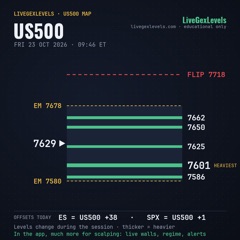
Reading the session · Episode 2
US500, Monday Oct 26, 2026: how we read the day
 Play the video · 2:48
On Monday the US500 opens higher, goes past the top edge of the expected move early and climbs to the high, just after eleven. In the afternoon it stays around 7680. The first trade is a quick scalp, at 9:45. On SPX the fast average is above the EMA 21, and both are rising.
A reading of a past session, not a signal and not a trade suggestion. Walls are model estimates. Points are hypothetical; past results do not guarantee future ones. Risk disclosure ↗︎
Chapters
Transcript
Show the full transcript
The narration of the video, as text.
Monday in one look
US500, Monday, October 26. Our reading: plus twenty-three points. Let's see how we read the day, and why.
One note on languages: we want these videos to be free and watchable in many languages, so the translations, the dubbing and the subtitles are made automatically. In some languages the voice may sound a bit odd.
The day
On Monday the US500 opens higher, goes past the top edge of the expected move early and climbs to the high, just after eleven. In the afternoon it stays around 7680.
The opening scalp
The first trade is a quick scalp, at 9:45. On SPX the fast average is above the EMA 21, and both are rising. Below there's the highest LVL level and no VG_GEX wall: above, the road is clear. Long, with a five-point stop, and out after half an hour: plus twenty-one points, after costs. Then the fast average keeps carrying price up to the high.
The spread on the 7680 wall
The second trade comes in the afternoon, at the top edge of the expected move. After almost an hour above the edge, two five-minute candles close back inside, and right above sits the VG_GEX 7680 wall, heavy and growing. And on SPX the candle closes below the fastest averages, with the bands tight. We sell the call at the wall and buy the one ten points higher: defined risk, no stop, to the close. In between price climbs back over the wall, and the spread goes against us, by about two points: no stop, but the risk is defined. At the close price is under the wall: the spread expires at zero and we keep the whole credit, plus two points, after a small cost.
The tally
Monday's tally: the scalp, plus twenty-one; the spread, plus two. In total, plus twenty-three index points.
How we read it
It's a reading, not a signal. If it helps you, subscribe and share the video. The free guide is in the description.