Learn · GEX
GEX (gamma exposure)
GEX, short for gamma exposure, is an estimate of how much option dealers would have to buy or sell the underlying to stay hedged as its price moves, mapped strike by strike.
How GEX is read
Option dealers usually hedge the delta of the options on their books, and gamma says how fast that delta changes as price moves. Where a lot of gamma sits at a strike, the hedging around that price can be large.
When dealers are estimated to be net long gamma, their hedging tends to lean against moves; when they are net short gamma, it tends to follow them. That is why traders watch GEX levels as zones where the market tends to decide, not as lines price must respect.
How LiveGexLevels shows it
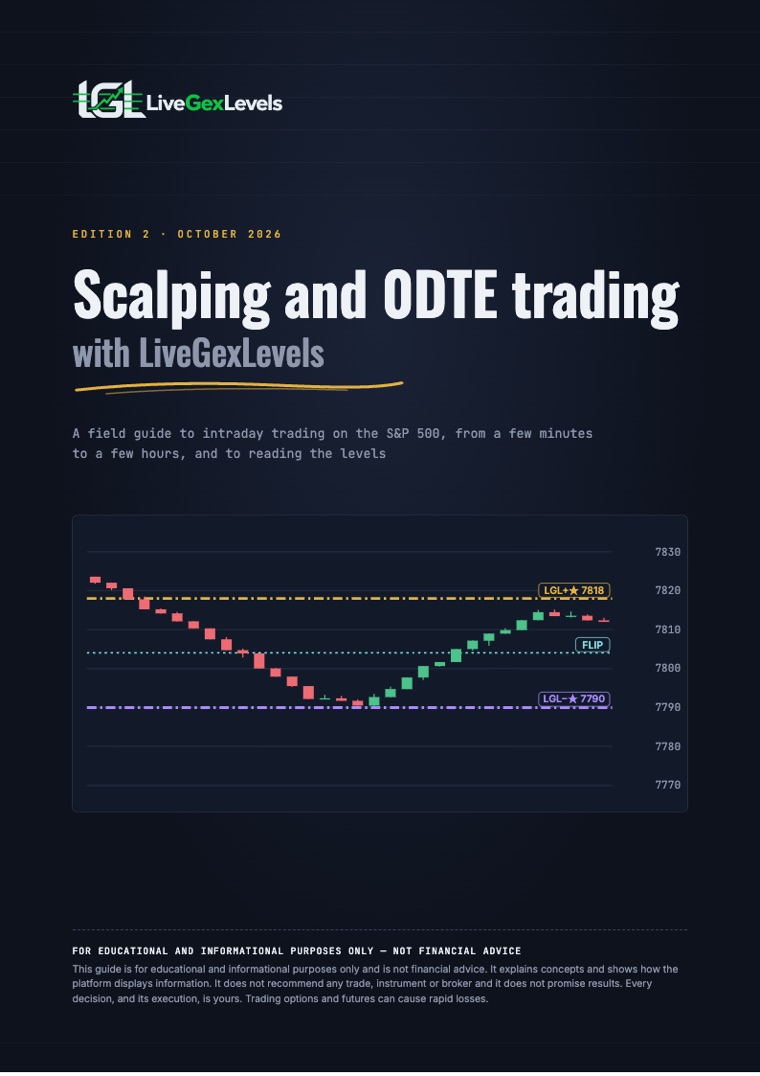
On LiveGexLevels, GEX levels are the prices where the map places concentrated gamma on the S&P 500 family: the call wall, the put wall, the gamma flip, the GEX centre of mass and lighter levels between them. Each level carries its relative mass, a trend (rising, new, stable, falling or fading) and n_markets: how many independent markets, among index, ETF and futures options, agree on its price.
The map also shows option-volume levels, the strikes where today’s option volume concentrates. They are a different measure from GEX, and the data keeps the two apart.
Which MCP tool returns it
get_gex_levels returns the levels top-down. explain_level describes one of them in plain words, and get_gex_regime returns the walls, the flip and the sign of the regime.
Questions and answers
Is GEX the dealers’ real position?
No. Dealer books are not public. GEX is a model that rests on an assumption about how dealers are positioned; the methodology page explains its limits.
Is a GEX level guaranteed support or resistance?
No. Price can run straight through a level, and the levels move during the session.
Which markets does LiveGexLevels cover?
The S&P 500 family only: SPX, XSP, SPY, ES and MES. No single stocks and no other indices.