Options School · Episode 4
In, At or Out of the Money: Buying, Selling and Exercising Options
 Play the video · 13:13
Your call is in the money: do you exercise it or sell it? One of the two leaves money on the table. The strike against the price, with a reserved concert ticket and then the index; intrinsic value and time value; buying, selling and exercising, and why you can ask to exercise an option out of the money but it never pays; American or European style, and assignment; the answer with a SPY call sold or exercised, and the exercise fees some brokers charge; what lands in your account (100 shares, cash or one future) and the futures on goods that can bring physical delivery; buying power and the margin call; early assignment before a dividend, and why earnings are a different risk; automatic exercise at expiry; options on the S&P 500 future: which expiries are American, how to tell them by the code, and the offset; the new /MES options settled in cash.
For information only. Not financial advice or an investment recommendation. Trading involves risk of loss. Risk disclosure ↗︎
Chapters
In brief
- In, at or out of the money compares the strike with the price: the same strike can be in for the call and out for the put.
- Before expiry, selling almost always gets you more than exercising: exercising throws the time value away.
- Options on stocks and SPY deliver 100 shares, index options pay cash, futures options one future, and a commodity future can bring the goods.
- Whatever arrives needs buying power, and a sold call can be assigned early before a dividend.
- At expiry, check your broker's rules, or close before.
The article
Read the article written from this video: In, at or out of the money: sell or exercise? →
Transcript
Show the full transcript
The narration of the video, as text.
The question
Your call is in the money. Do you exercise it, or sell it? One of the two leaves money on the table. Let's see which one, and why.
Welcome
Welcome to the LiveGexLevels options school. One idea at a time, from the first contracts in history to the strategies traders use today. One note: languages are dubbed automatically, so the voice may sound a bit odd. This is education, not advice. You decide, and you trade with your own broker.
Fourth episode: in, at or out of the money; buying, selling and exercising; what lands in your account, and its risks; and, at the end, the options on the S&P 500 futures.
In, at or out of the money
A real case first. You've reserved a concert ticket at 50: until the concert, you can pay 50 and collect it, or let it go. It's a right to buy, like a call, with a strike of 50. If the same ticket now sells for 80, your reservation is in the money: it's worth at least the 30 you'd save. If it sells for 50, it's at the money. If it sells for 30, it's out of the money: nobody pays 50 for a ticket that costs 30. For short: ITM, ATM and OTM.
On the index it's the same comparison: the strike against the price. With the index at 7,800, a call with strike 7,600 is in the money: 200 points. Here's a detail that's rarely said: a put with that same strike is out of the money: it pays only if the index falls below 7,600. Those 200 points are the intrinsic value: what the call would pay if it expired now. But the model prices it at 276. The other 76 are time value: the price of what can still happen. Time value is largest at the money, where the outcome is most uncertain: the call at 7,800 is all time value, 148 points.
Buy, sell, exercise
An option has a price, then, and it can change hands. What can you do with it? Three things. Buying means paying the premium to get the right. Selling means two things: closing an option you own, which is what we look at today, or opening a new one, on the side that has the obligation: that's the next episode, the short call. Exercising means using the right: buying, or selling, at the strike.
Can you exercise only an option that's in the money? No. You can ask your broker to exercise one that's out of the money too, but it never pays: you'd buy above the market price. What's limited to options in the money is the automatic exercise at expiry, and we'll get to it.
American or European
When can you exercise? It depends on the style. American: any trading day, up to expiry. European: only at expiry. Options on stocks are American, and so are those on SPY, the ETF that tracks the S&P 500. Options on the index, SPX and XSP, are European. And the other side: when someone exercises, someone who sold that option is assigned, and is bound by the contract. That's assignment. Whoever sold an American option can be assigned before expiry; whoever sold a European one, only at expiry.
Sell or exercise?
Now we can answer the opening question. Take an American call on SPY: SPY at 780, strike 760, a month to expiry. One contract is 100 shares, and we'll see why in a moment. The model prices this call at 2,760 dollars a contract. Sell it, and you receive 2,760. Exercise it, and you buy 100 shares at 760 that are worth 780: 2,000 dollars of value. The difference, 760 dollars, was time value, and exercising throws it away. That's the answer: before expiry, selling almost always gets you more than exercising.
And there's one more cost to check. Some brokers charge a fee to exercise, or when you're assigned, and it can be higher than the commission on a normal trade; others charge nothing. It's in your broker's fee list.
What lands in your account
And if you do exercise, or hold to expiry, what lands in your account? On stocks, one contract is 100 shares. Why 100? The official rules don't explain it. The most likely reason is history: 100 shares was the round lot, the normal trading unit on Wall Street, and the first listed options, in Chicago in 1973, took that unit.
And SPY works the same way: it's an ETF, but its options work like those on stocks, not like those on futures: 100 shares, American style, shares delivered. Index options settle in cash: there's nothing to deliver. And on futures, one option is one future, not 100.
Futures on goods: the delivery
One future: and that's worth a closer look. The S&P 500 future settles in cash, but many futures are on goods: oil, wheat, cocoa. An option on one of those futures gives you the future, and a future held into its delivery period can bring the goods themselves. It has happened, on purpose: in July 2010, a London hedge fund, Armajaro, took delivery of about 240,000 tonnes of cocoa through the futures market: close to a billion dollars of beans, as the press reported at the time. For a private account it's the scenario to avoid, and many brokers close these positions, or ask you to, before the delivery period.
The buying power risk
Shares, a future, goods: whatever arrives has to be paid for, or covered with margin. That's the buying power risk. Exercise the SPY call at 760, or let it be exercised at expiry, and you have to pay 76,000 dollars for the shares: buying power you may not have. With a put it's the other way around: 100 shares leave your account. If you don't hold them, you end up short.
On the options on the ES future it's the same story, only bigger. An exercised call becomes one ES future: about 390,000 dollars of index at 7,800, held with a margin of about 28,000 dollars, as we saw with the long call. If the account can't carry it, a margin call follows: the broker asks for more money, or closes positions. That's why the broker may close the position before expiry, by its own rules. And you can close it yourself first.
Early exercise and dividends
Closing first protects whoever bought. Whoever sold has a different risk: being assigned early, and there's one moment when it's likely. On SPY a dividend is paid every quarter, and it goes to whoever owns the shares before the ex-dividend date. So whoever holds a call in the money may exercise it the day before, to own the shares in time. It pays when the dividend is bigger than the time value left in the call, which exercising throws away. So whoever sold that call can be assigned early, exactly then.
Earnings are a different matter. Around the announcement the risk is not early exercise: it's the price, which can gap, and implied volatility, which usually drops right after.
Automatic exercise
And if you do nothing until expiry? In the United States, on stocks, ETFs and indices, the clearing house, the OCC, exercises by itself every option that's in the money by at least one cent. It's called exercise by exception. If you don't want it, you have to tell your broker, before its cut-off time. And every broker has its own rules: cut-off times, fees, positions closed early. You need to check them, to know how to act.
Options on /ES: style and offset
So far, stocks, ETFs and indices. On the options on the S&P 500 future, ES, the style depends on the expiry, and this is where many get confused. Only the quarterly ones are American: March, June, September and December, expiring on the third Friday, at the open. All the others are European: the weeklies, from Monday to Friday, and the end of month. To tell them apart, look at the product code: ES is the quarterly, American; every other code is European. With a European one, nobody can exercise before expiry: until that day you can sleep soundly. With an American quarterly, early assignment is possible, though rare.
At expiry, an option in the money becomes a future. What if you don't want it? On futures you don't sell a position back: you open the opposite one, and the two cancel out. That's called an offset, and the account ends flat. A case: your ES call ends in the money, and you get a long ES future you don't want to hold. You sell one ES, and the two positions offset. From a put you'd get a short ES, and you'd buy one. And here's a practical tip. On the European ones, the outcome is decided by the fixing, a reference price for the future, set at three in the afternoon, Chicago time, four in New York. From that moment you already know whether the future will arrive, but it shows up in your account only later, overnight. So you can open the opposite position straight away, before the daily pause at four, Chicago time, or when trading reopens at five. When the future arrives, the two offset. The limit: on the American quarterlies, the outcome isn't certain until the evening processing. If you open the opposite position and then the future doesn't arrive, you're left holding an open future.
/MES: now settled in cash
And one last detail, a recent one. Since the end of June 2026, the new options on the micro S&P 500 future, MES, are European and settled in cash, like an index. At expiry no future arrives: whoever holds one in the money receives the difference between the fixing and the strike, 5 dollars a point. Before, they delivered a future, like ES.
In brief
In brief. In, at or out of the money compares the strike with the price: the same strike can be in for the call and out for the put. Before expiry, selling almost always gets you more than exercising: exercising throws the time value away. Options on stocks and SPY deliver 100 shares, index options pay cash, futures options one future, and a commodity future can bring the goods. Whatever arrives needs buying power, and a sold call can be assigned early before a dividend. At expiry, check your broker's rules, or close before.
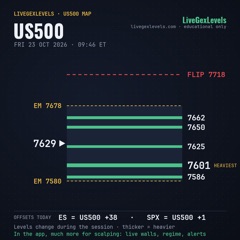
On the S&P 500, LiveGexLevels estimates during the session where the dealers' hedging piles up: useful levels to have in front of you when you plan where to get in and where to get out.
Up next
Next episode: the short call, the other side of the trade, where you collect the premium and the obligation is yours. We take requests, so tell us in the comments what you'd like us to explain. Before risking real money, practise with paper trading. And the guide is free with our newsletter, on livegexlevels.com. And to see the levels live, sign up on the platform: right now there's a launch price, which you keep for as long as you stay subscribed, and a free trial.