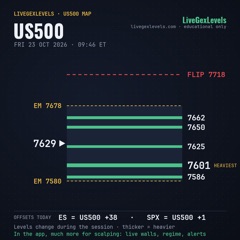
Shorts
Who Bought Your Call? Positive Gamma, the Dealer's Brake
 Play the video · 1:47
You sell a call, and most of the time a market maker buys it. He doesn't bet on the direction: he hedges with ES, selling the rises and buying the dips. That's positive gamma, and the price tends to slow down near the strike.
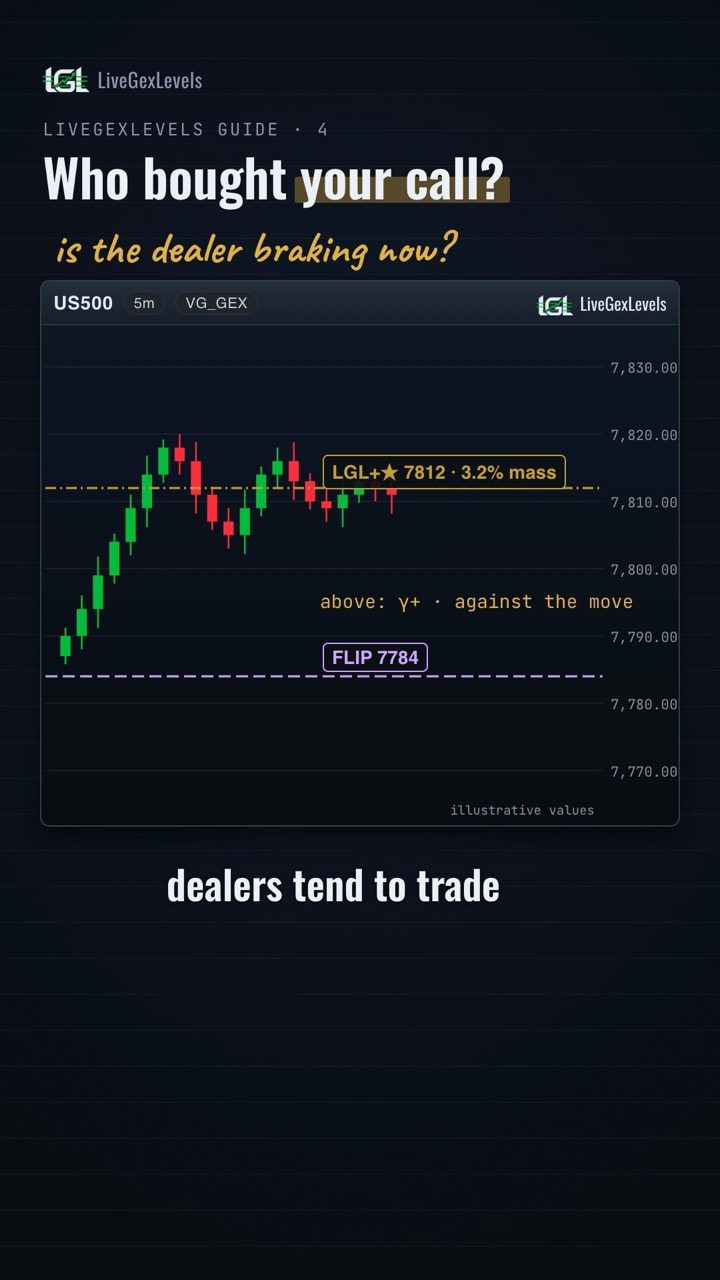
On LiveGexLevels the FLIP line splits the US500 chart during the session: above it gamma is positive and dealers tend to trade against the move; below it they tend to chase the price.
For information only. Not financial advice or an investment recommendation. Trading involves risk of loss. Risk disclosure ↗︎
Transcript
Show the full transcript
The narration of the video, as text.
You sold a call. Who bought it? Most of the time, a market maker. And right away, he sells ES to hedge.
Customers sell one thousand calls at the money, and the market maker buys them: he is long one thousand calls. With delta at one half, it's as if he had bought about one thousand ES. He doesn't want that bet: he earns on the spread, not on the direction. So he hedges right away: he sells about one thousand ES. Calls plus ES: net delta, zero.
Let's watch it in motion. The index slips ten points, and he buys back about twenty-four ES. Another ten down, and he buys back again. It bounces, and he sells. It climbs above the strike, and he sells more. And when it comes back down, he buys. Every time, against the move.
He sells the rises and buys the dips, so the price is braked, and it tends to stay near the strike. That's positive gamma. So the same game, two hours from expiry, moves hundreds of ES every five points, right around the strike.
On LiveGexLevels you see which side you're on, during the session. The FLIP line splits the chart in two. Above it, gamma is positive: dealers tend to trade against the move, and the walls tend to hold more. Below it, they tend to chase the price.
The full episode, positive gamma, is on our channel.