Video guide · Episode 1 · Part 1
Who moves the price
Price stops at the same level twice, then runs straight through it. Who has to trade at that price, and why? Why large investors hedge with index options, how the dealers' hedging turns into real buying and selling, and how GEX estimates where that hedging piles up: the levels and the walls.
 Watch on YouTube · 5:36
Chapters
In brief
- News, large orders and option hedging move the price: only the third follows rules that can be read.
- Dealers long gamma dampen the moves; dealers short gamma amplify them.
- Walls are where hedging concentrates; the flip is where the regime changes.
The same summary closes chapter 3 of the free guide, where the topic continues in writing. Get the free guide →
Transcript
Show the full transcript
The question
Price stalls at the same level once, then again, and one day it runs straight through. It isn't your indicators, and it isn't yesterday's high. Someone has to trade at that price. Who, and why?
Welcome
Welcome to the LiveGexLevels guide series. One idea at a time, to read the S&P 500 during the day through option hedging. This is education, not advice: you decide, and you trade with your own broker.
Episode one: who moves the price. Why options, why the index, why the dealers' hedging, and why GEX and its levels.
Three forces
During the day, three big forces move the index. News: economic data, central banks, a headline. Large orders: funds and institutions entering or leaving. And the hedging of options. The first two are hard to anticipate. The third follows rules, and it can be read. So let's be clear: we read one force out of three. That's where an edge is possible: knowing where to look before the price gets there. And for now, only there.
Why options
Why options? Because they are one of the main ways big investors protect themselves. We'll explain options step by step in the coming episodes. For now, one of their many uses is enough. They can protect a portfolio against falls, like an insurance policy. And as the course goes on, every concept will become clearer. And why the index? A fund that owns hundreds of stocks doesn't hedge them one by one. It buys or sells options on the index: one instrument covers the whole basket. It's liquid, and the index is steadier than a single stock.
And the volumes are huge. That's why you often hear people say: options move the market. What does that mean? An option, on its own, doesn't buy or sell the index. But every option has someone on the other side.
The dealer
On the other side there is usually a market maker: the dealer. Whether you buy an option or sell one, the dealer doesn't want to bet on the direction. So the position is hedged, by buying or selling the underlying in the right amount. And as the price moves, that hedge has to be adjusted, again and again.
Now multiply that by every option that's still open. All that hedging is real buying and selling, every day, big enough to push the price. That's what “options move the market” really means: not the options themselves, but the hedging behind them.
GEX and the walls
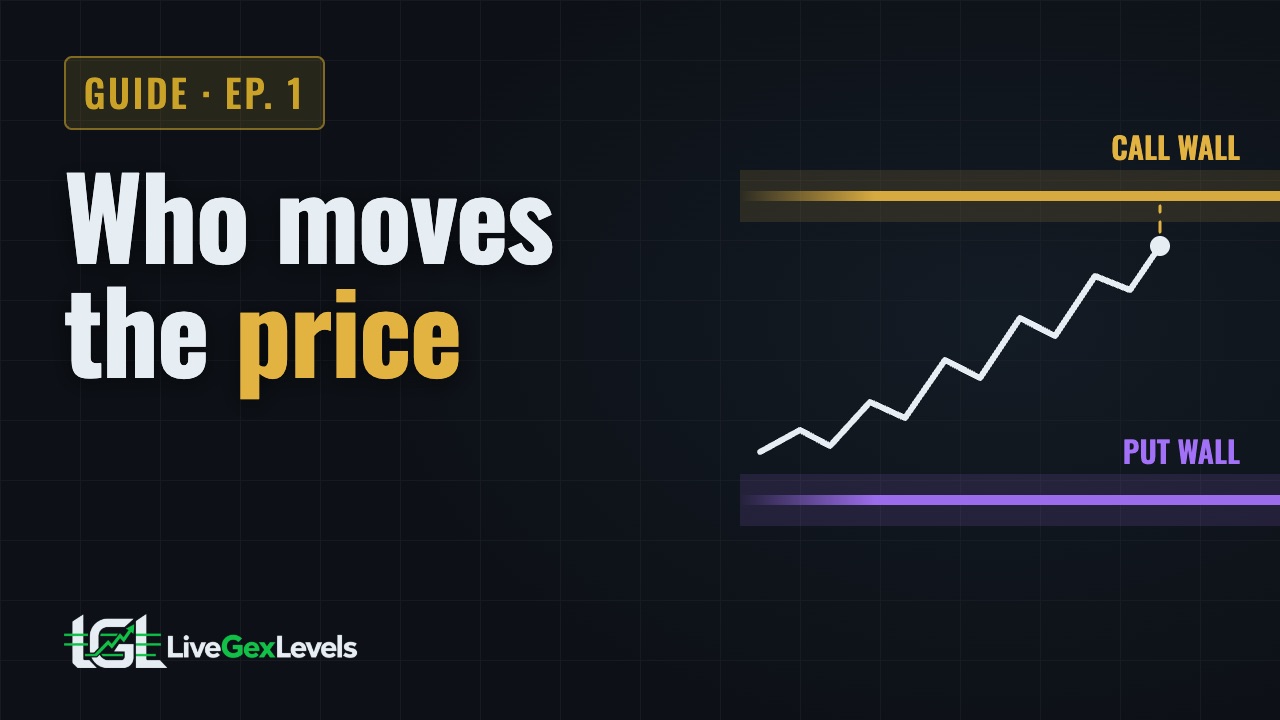
Where does all that hedging pile up? Gamma exposure, GEX, estimates it price by price: how much the dealers must buy or sell when the price moves. Where many options sit on the same strike, the hedging piles up. That price becomes a level, and when it's heavy, we call it a wall. It's an estimate from a model, not an order in the book.
Back to the chart
Now, back to the chart we started with. The first two times, the price came down onto a heavy wall, made of options the dealers had bought. As it got close, the dealers had to buy the underlying to stay hedged, and that buying helped the price bounce back up. But between one touch and the next, positions were being closed, and the wall kept getting lighter. On the third touch, there was almost nothing left to hedge. The dealers no longer had to buy, and the price went straight through. So that's the answer to our opening question — the dealers, and their hedging.
That's just one way it can play out. Here, the dealers' hedging put the brakes on the drop. Other times it does the opposite, and amplifies the move. And remember, it's one force out of three: news and large orders can override any wall. We'll go through these dynamics in detail in the coming episodes.
In brief
In brief: big investors protect themselves with options on the index. Dealers take the other side, and their hedging moves the price. GEX estimates where it piles up: the levels. So our idea is simple: follow the GEX levels and how they change, throughout the session. That's where the name comes from: Live, GEX, Levels. Put together: LiveGexLevels. That's who we are, and much more.
Up next
Next episode: options, explained simply. Calls, puts, strike, expiry, and the ones that expire the same day. We'll keep going deeper, and we take requests: tell us in the comments what you'd like to see. And before risking real money, practise with paper trading. The guide is free with our newsletter, on livegexlevels.com.