LiveGexLevels Guide
Why the Market Goes Against You the Second You Enter (GEX Levels, S&P 500)
 Play the video · 4:13
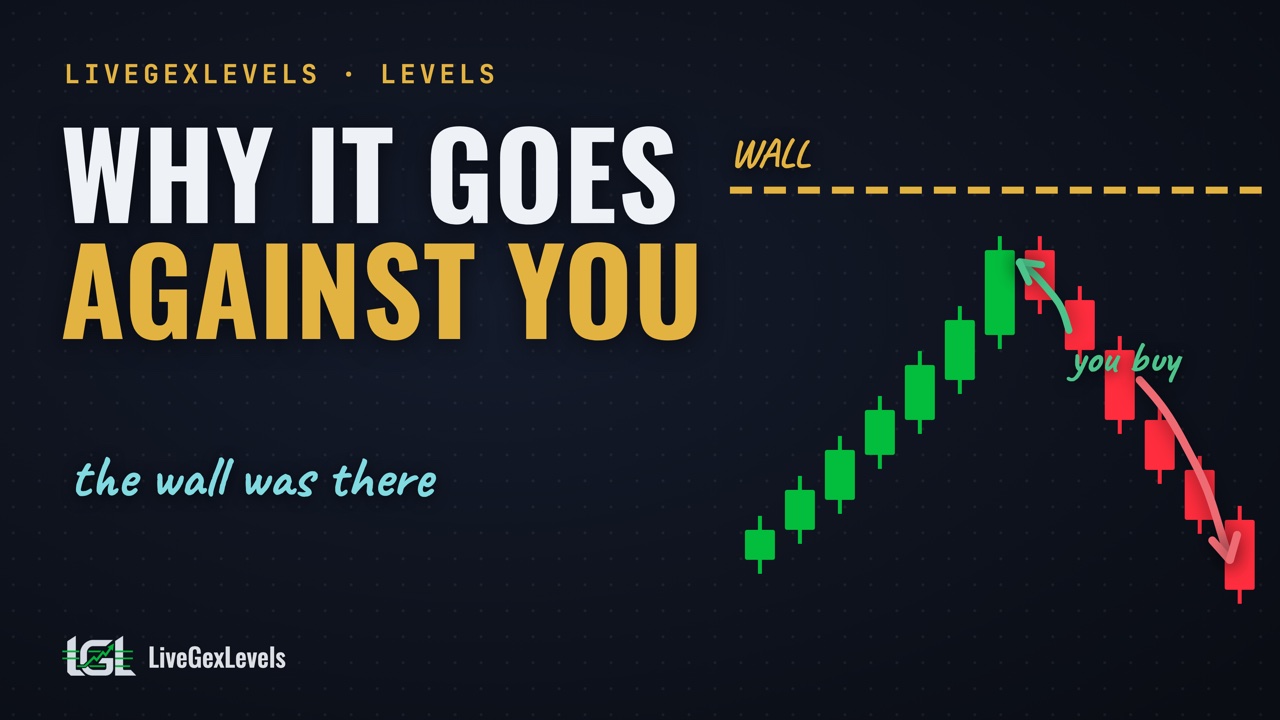
You buy, and it drops. You sell, and it climbs back. The market isn't watching you: it goes where the orders are, and where the options dealers' hedging is. Two reasons, on the chart: the break above the high and the stop under the low are where most orders sit, so that's where the price goes to find them; and where options pile up, dealer hedging becomes a wall that slows the price, so buying the break right under a wall is buying exactly where the hedging sells. Below the gamma flip the same hedging pushes the other way. First touch, respect it. Retest, no favour.
For information only. Not financial advice or an investment recommendation. Trading involves risk of loss. Risk disclosure ↗︎
Chapters
In brief
- The market isn't watching you: it goes where the orders and the hedging are.
- The obvious entries, the break above the high and the stop under the low, are where orders pile up, and the price goes to find them.
- Where options pile up, the market makers' hedging becomes a wall that tends to slow the price: buying the break right under it is buying where the hedging sells.
- Below the gamma flip the same hedging pushes the other way: breaks tend to run.
- First touch, respect it; retest, no favour. Walls are model estimates, not orders and not barriers.
- You don't have to guess the direction: know where the brakes are, and which way the hedging pushes, before you click.
The article
Read the article written from this video: Why does the market go against you the second you enter? →
Transcript
Show the full transcript
The narration of the video, as text.
The question
You buy, and it drops. You sell, and it climbs back. It feels like the market is watching you. It isn't. But someone does move every time the price reaches a level. On Friday, at 10:23, the price came down to a line we had drawn before the open. It touched it, and climbed 28 points. In three minutes you'll know why, and where to look before you click.
One note: languages are dubbed automatically, so the voice may sound a bit odd.
Why it happens, where to look
Here you get the answer in two parts. Why it happens, and where to look before you click. Every morning, the levels on the LiveGexLevels page. They are there before the open, and sharp in the first minutes of the session. Every evening, here on the channel, the reading of the session. If you trade the S&P 500, subscribe now.
Where you enter
First reason. You enter where everyone enters. The break above the high. The stop just under the obvious low. Those are the places with the most orders. So that's where the price goes to find them. And once they're filled, it turns. It isn't about you. It's about where the orders are.
The hedging
Second reason, the one a chart doesn't show. Options. Whoever buys or sells an option faces a market maker. He doesn't bet. He hedges, buying and selling the future. Where options pile up, his hedging becomes a wall that slows the price. You buy the break right under that wall. And you're buying exactly where the hedging sells. That's your trade that went against you.
Which side of the flip
And it flips. Below a level we call the flip, the same hedging pushes the other way. Breaks run, and it's going against them that fails. Same chart, opposite behaviour. If you don't know which side you're on, half of your trades are fighting the hedging.
On the US500 page
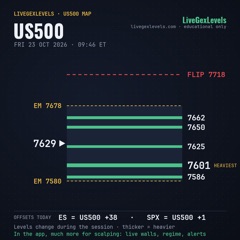
Here's how we show it. The dashed lines are the walls, with their weight. The band is the day's expected move. Friday, 10:23. The price comes down to the 7600 wall for the first time, touches it, and climbs 28 points to the next wall. The second time, after 11:30, the wall gives way. First touch, respect it. Retest, no favour. A rule you can only use if the wall is on your chart before the price gets there.
Not every wall holds
Not every wall holds. It depends on the weight and the context. A light wall gives way, a heavy one tends to hold. And on days that open wide, the trend wins. We say that too, every evening.
Your edge
So no, the market isn't watching you. It's going where the orders and the hedging are. You don't have to guess the direction. You have to know where the brakes are, and which way the hedging pushes, before you click. That's information a chart alone doesn't give you. Your edge starts with preparation.
The levels, every day
Want the levels on the page every day? Sign up to LiveGexLevels. The link is below. A launch price you keep for as long as you stay subscribed, and a free trial. And subscribe to the channel. Every evening there's the reading of the session. Be at the level before the price gets there.