LiveGexLevels Guide · Episode 4
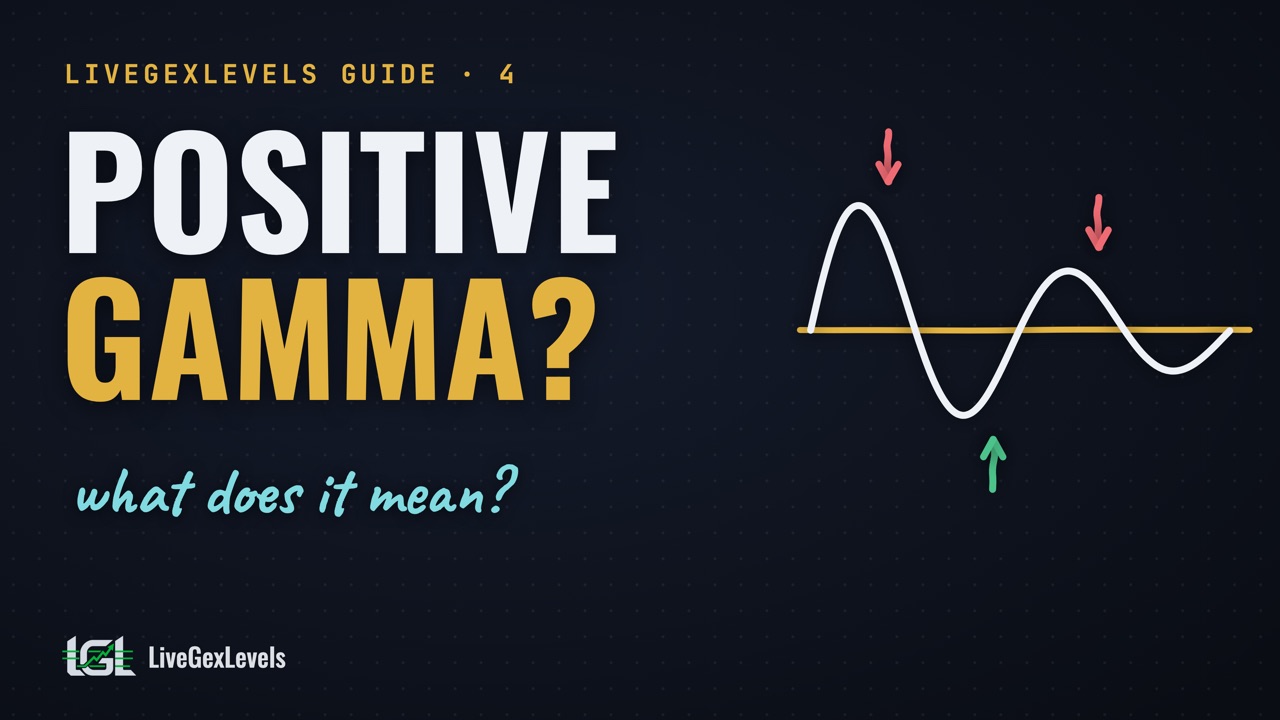
Positive Gamma: What Does It Mean? Delta Hedging Explained
 Play the video · 10:37
When a customer sells a call, a market maker usually buys it: he is long the call, and he doesn't want to bet on the direction. So he hedges with ES futures: an at-the-money SPX option moves about like one ES, so 1,000 calls need about 1,000 ES sold. Then he rebalances as the index moves: down, he buys ES back; up, he sells more. That's delta hedging. Close to expiry the delta curve becomes a step, and the same adjustments turn into large flows around the strikes. Because he is long the options, his gamma is positive: he trades against the move, and the price tends to slow down at the levels. Model numbers on an illustrative index. Education, not advice: trading can lose money.
For information only. Not financial advice or an investment recommendation. Trading involves risk of loss. Risk disclosure ↗︎
Chapters
In brief
- Customers sell the call; the market maker buys it, and is long.
- He hedges with ES, about one for each at-the-money SPX option, and keeps adjusting: he sells when the index rises and buys when it falls. That's delta hedging.
- Near expiry, the adjustments become large flows around the strikes.
- Long options mean positive gamma: the market maker trades against the move, and the price tends to slow down at the levels.
The article
Read the article written from this video: Positive gamma: what does it mean? →
Transcript
Show the full transcript
The narration of the video, as text.
The question
Positive gamma: what does it mean? Watch the price near a level. It rises, and someone sells. It falls, and someone buys. And the swings get smaller and smaller. Who is braking the price? And why do traders call it positive gamma?
Welcome
Welcome to the LiveGexLevels guide series: one idea at a time, to read the S&P 500 through options. One note: languages are dubbed automatically, so the voice may sound a bit odd. This is education, not advice: you decide, and you trade with your own broker.
Today: who is on the other side when you sell a call. Then how the market maker hedges it, point by point. And finally what changes close to expiry, and what positive gamma really means.
The other side
When a customer sells a call, someone buys it, and most of the time it's a market maker. Why do market makers exist? Without them it would be very hard to find someone who takes the other side of your trade exactly when you want, at the strike and the expiry you choose. The market maker stands on the other side and keeps trades flowing: he makes the market, hence the name. The customer sells: he collects the premium, and takes on the obligation. The market maker buys: he is long the call. He pays the premium, and owns the right. Look at the two charts at expiry: the same hockey stick, upside down. What one gains, the other loses. The short call gets its own episode in the options school. Here, we follow the market maker.
The delta curve
To hedge, he looks at one number: delta. We met delta with the long call, in the options school. Delta tells you how much the option moves when the index moves one point. Far below the strike, the call barely moves: delta is close to zero. Far above, it moves like the index: delta is close to one. At the money, right at the strike, delta is about a half. Now, a useful fact to remember. One SPX option is worth one hundred dollars for each index point. With delta at one half, that's about fifty dollars a point. And one ES future is worth exactly fifty dollars a point. So one at-the-money SPX option moves about like one ES.
The hedge
Now the hedge. Customers sell one thousand calls at the money, and the market maker buys them: he is long one thousand calls. With delta at one half, it's as if he had bought about one thousand ES. He gains if the index rises, and he loses if it falls. He doesn't want that bet: he earns on the spread, not on the direction. So he hedges right away: he sells about one thousand ES. Calls plus ES: net delta, zero.
Now let's move the index one point at a time. On top, the value of his calls. Below, his ES. One point down. The calls lose about fifty thousand eight hundred dollars, and the ES he sold gain about the same. Total: about zero. This is how the protection works: what the calls lose, the market maker gains back on the ES. But the balance changes as the price moves. Let's see what happens if the index drops one more point. The calls lose a little less this time, because their delta has dropped. The ES gain exactly the same as before. The calls are a curve; the ES are a straight line. Now there's an imbalance: he is a little too short. To keep the balance, he closes some of his short ES, which means buying ES. And buying while the price falls slows the move down. Now the other way. Back to the strike, and one point up: the calls gain about as much as the ES lose. One more point up: the calls gain a little more, and the ES lose the same. To stay balanced, he has to sell ES, and the higher the price goes, the more he sells. Selling while the price rises slows it down as well.
Delta hedging
Let's watch it in motion. The index slips ten points, and he buys back about twenty-four ES. Another ten down, and he buys back again. It bounces, and he sells. It climbs above the strike, and he sells more. And when it comes back down, he buys. Every time, against the move.
This is called delta hedging: keeping the delta of the position close to zero, by buying and selling the underlying as the price moves. Retail traders use it too, in some option strategies. But for them every trade in ES has a cost, so you hedge when it pays, not at every tick. The market maker is in a different position. As a liquidity provider, he usually has agreements with the exchanges that cut his fees, and he trades close to the bid and the ask himself. So hedging costs him far less than it costs a retail trader. In later videos we'll see strategies that collect time value while hedging their delta, and the risk that remains when the price moves a lot.
Near expiry
Now let's bring everything close to expiry. We keep the same option, and the same strike. Thirty days out, the delta curve is soft, spread over hundreds of points. Two hours before expiry, it becomes a step: from almost zero to almost one, within a few dozen points. For the same twenty-point rise, his thousand calls need forty-seven ES sold at thirty days, and seven hundred and forty-one at two hours: about sixteen times as much. That's gamma: how fast delta changes, the slope of the delta curve.
So the same game, two hours from expiry, moves hundreds of ES every five points, right around the strike. Thirty days out, it was about a dozen. The small adjustments we saw become real flows. That's why the options closest to expiry, the ones expiring today or tomorrow, weigh the most on the moves of the underlying: per contract, near the strike, their hedging is many times larger. And the strikes with the heaviest positions turn into levels the price can feel.
The whole book
Of course, a market maker doesn't hedge one call at a time. He holds thousands of positions, on many strikes and expiry dates, calls and puts, some long and some short. Deltas add up, so he nets them all into one delta for the whole book, and he hedges it in steps, mostly with ES, thousands at a time. Gamma he watches expiry by expiry, because the closest expiries change the fastest. The Greeks get their own episodes in the options school: here, the idea is enough.
Positive gamma
So, positive gamma: what does it mean? First: customers sold, so he is long the options. Long options always have positive gamma; short options have negative gamma. And the sign that matters is the market maker's. Second: with positive gamma, his delta follows the price. The index rises, his delta rises, and he sells ES. The index falls, his delta falls, and he buys. Third: he trades against the move. He sells the rises and buys the dips, so the price is braked, and it tends to stay near the strike. In the first episode we said that dealers sometimes brake the price and sometimes amplify it: this is the brake. If instead customers buy options, he is short, gamma is negative, and he has to chase the price: that amplifies it, and it's the next episode. With positive gamma, levels tend to hold more.
In brief
In brief. Customers sell the call; the market maker buys it, and is long. He hedges with ES, about one for each at-the-money SPX option, and keeps adjusting: he sells when the index rises, and buys when it falls. That's delta hedging. Near expiry, the adjustments become large flows around the strikes. Long options mean positive gamma: the market maker trades against the move, and the price tends to slow down at the levels.
Up next
Coming up in the guide: negative gamma and the gamma flip, or what happens when customers buy options instead. Tell us in the comments where you've seen the price slow down at a level. Before risking real money, practise with paper trading. The guide is free with our newsletter. You'll find it on livegexlevels.com. Seeing where dealers have to hedge is information a chart alone doesn't give you. Your edge starts with preparation. To see the levels live, sign up on the platform. There's a launch price, and you keep it for as long as you stay subscribed. And there's a free trial.