LiveGexLevels Guide · Published
The only two real edges in options
Not two hundred strategies: two advantages built into how the market works. One is slow and calm, and fear pays for it; the other is fast, and attention pays for it.
 Watch on YouTube · 8:14
Selling fear
First, a word on the term. An edge is an advantage you can prepare for, not a promise: with both of the edges in this article, you can lose money.
The first edge comes from fear. Big investors buy puts on the index to protect their portfolios: it's insurance. And like any insurer, whoever sells that protection asks for more than the damage it pays out on average.
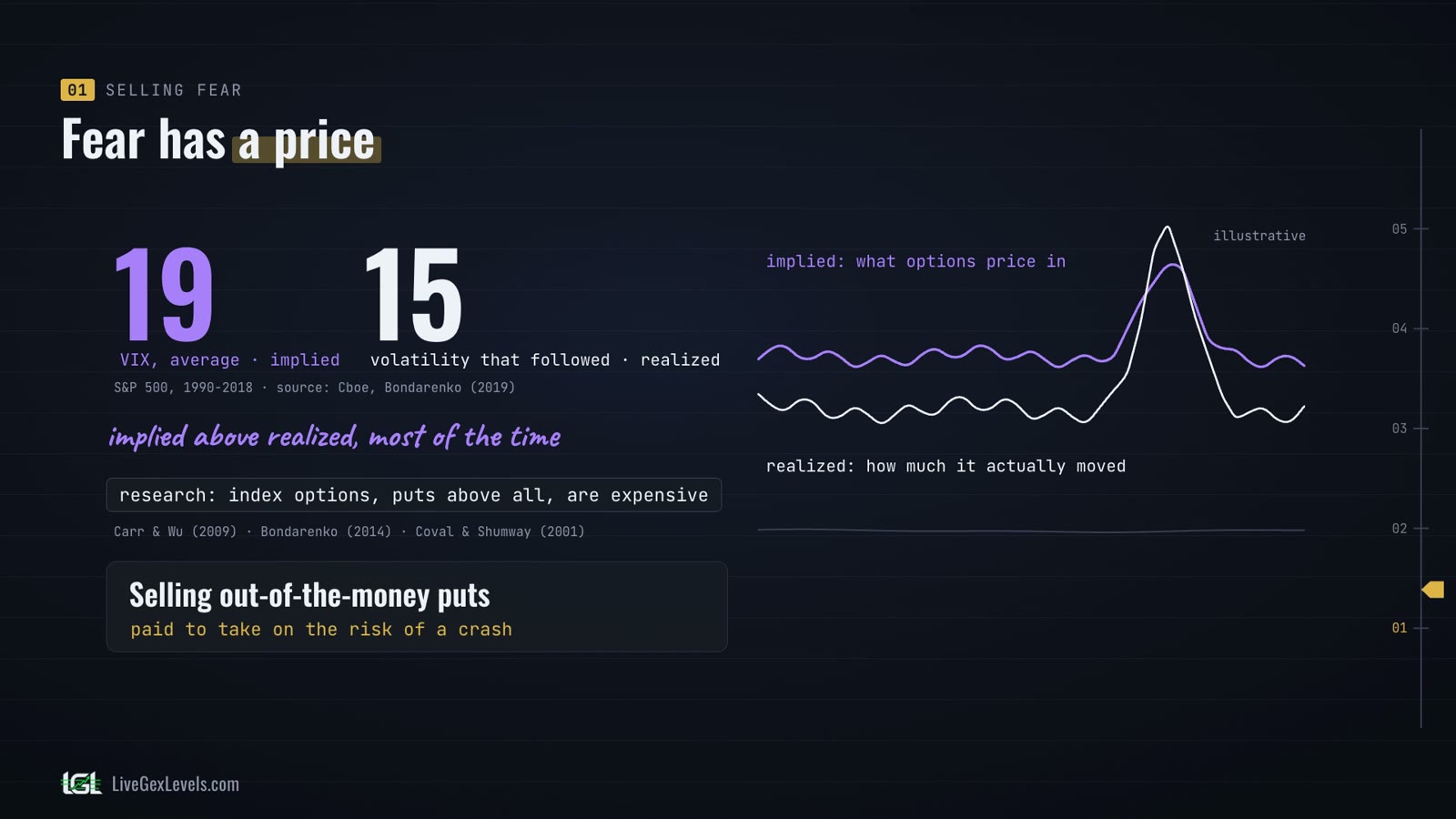
You can see it by comparing two volatilities. Options have a volatility built into their price, the implied volatility: the market's estimate of how much the index will move. Then there's the realized volatility: how much it actually moved. Between 1990 and 2018 the VIX, the implied volatility of the S&P 500, averaged about 19; the volatility that actually followed was about 15. Implied above realized, most of the time.
Academic research finds the same thing: options on the index, puts above all, are expensive. So, over time, selling out-of-the-money puts has a known statistical edge. You're being paid to take on the risk of a crash.
And that's the catch. The premium comes in small amounts, and the risk arrives all at once. In March 2020, Cboe's put-selling index on the S&P 500 lost about 29 percent in a single month, back to where it had been four and a half years before. Years of modest gains, gone in a few weeks.
What can you do? Protect the portfolio, meaning all your positions together, so that what you spend on protection doesn't eat up what you earn. Nothing in options comes for free, but by combining the right strategies you can build a portfolio that limits the damage of a crash and still collects the edge of selling options. You can avoid blowing up the account in the big crashes, and even build a portfolio that gains from them: it all comes down to managing the curve of the portfolio. These advanced strategies come in later episodes.
It's a relatively calm way to trade: the price has to move a lot before it causes trouble. Gains come slowly and steadily, but they're modest, and it takes real capital: selling puts ties up a lot of buying power, even in a well-built portfolio. One more fact, to be fair: since 2007, Cboe's put-selling index has swung about two thirds as much as the S&P 500, and it has also earned less. Smaller swings, not bigger returns.
In the very short term
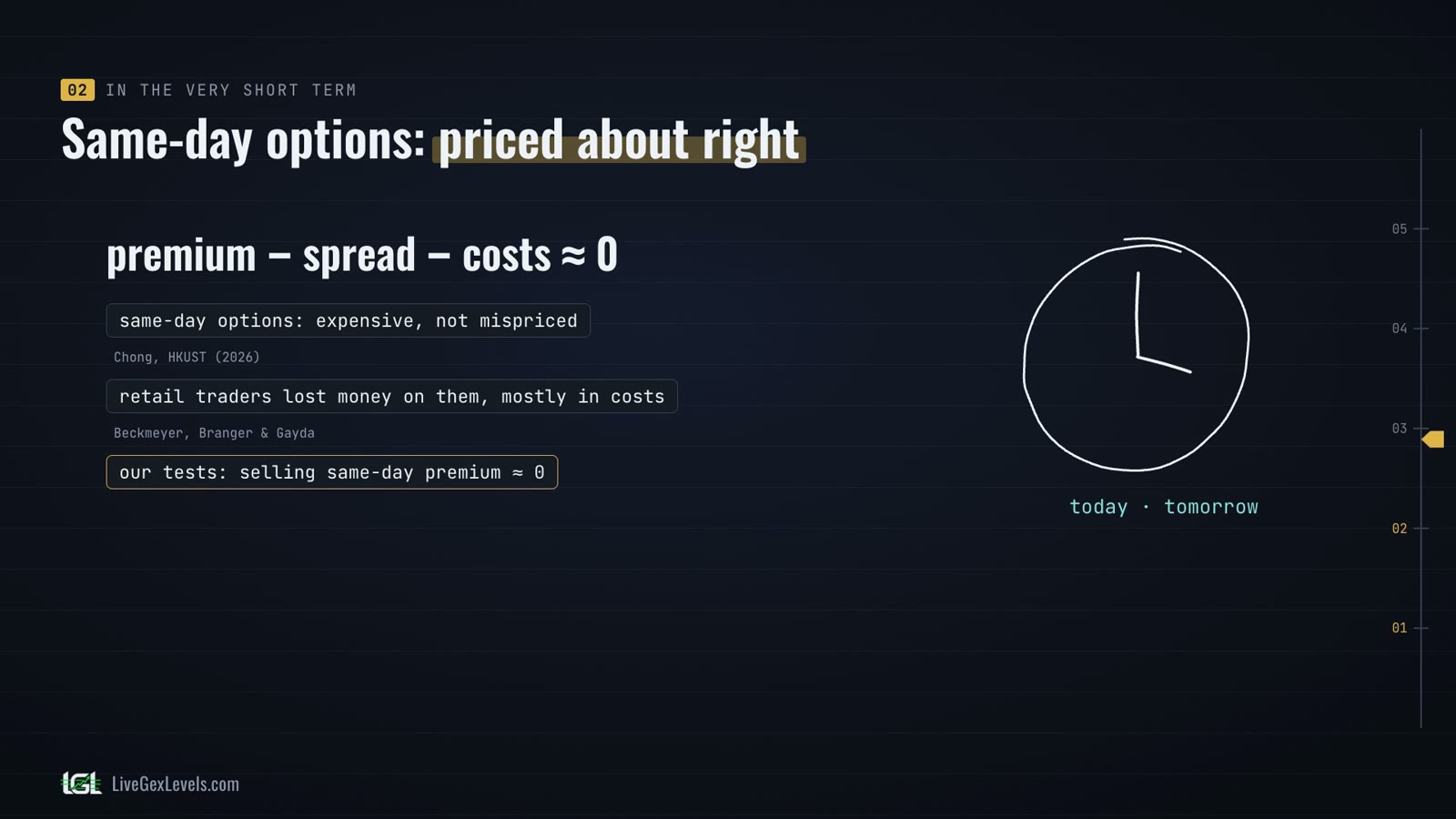
Now shrink the clock, to options that expire today or tomorrow. The premium is still in the prices, but once you pay the spread and the costs, there's nothing left to collect.
Research points the same way. One study of same-day options found them expensive, but not mispriced. Another found that retail traders lost money on them, mostly in costs. In our tests, selling same-day premium came out at about zero.
So in the very short term, the edge isn't in selling time. It's somewhere else.
Reading the dealers
The second edge is reading the dealers' positioning while the session is running. Every option has a dealer on the other side, who hedges by buying or selling the underlying. GEX estimates where that hedging piles up: the levels, and the heaviest ones, the walls.
Research on the S&P 500 finds that when dealers are short gamma, the day's move tends to keep going into the close; when they're long gamma, it doesn't. And on expiry days, prices tend to be drawn toward the big strikes.
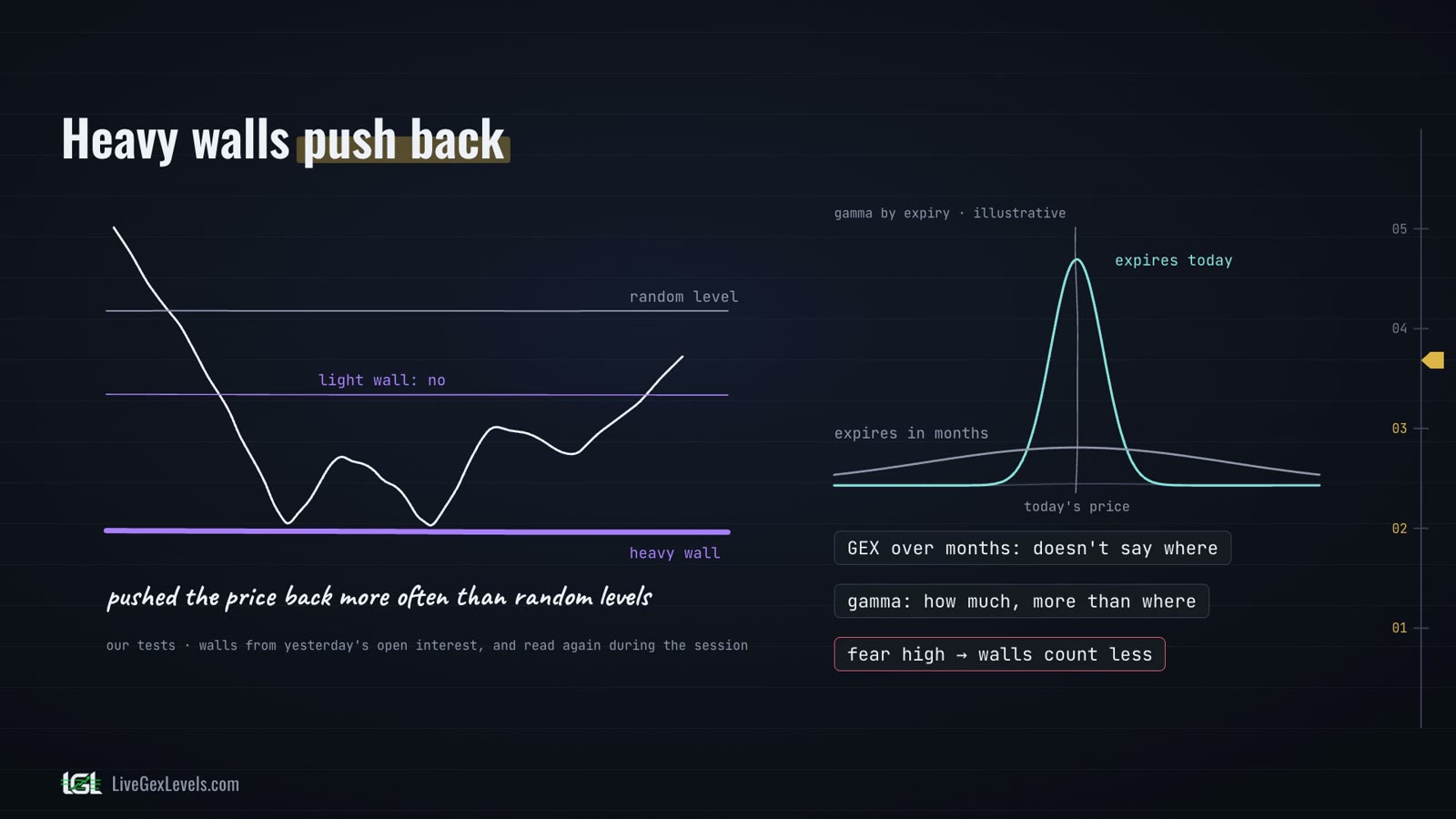
In our tests, the heavy walls, built from yesterday's open interest and read again during the session, pushed the price back more often than levels picked at random. The light walls didn't.
What about GEX over weeks or months? It doesn't tell you where the market will go. Positions that expire months away have little gamma near today's price, so they weigh little. Gamma says more about how much the market moves than about where. And when fear runs high, the walls count for less.
This edge asks for more: attention, speed, discipline. Moves are quick. It doesn't need a large account, but gains and losses both come fast. And here the options aren't the source of the edge, because in the very short term they're priced about right. The edge is in the data: knowing where the dealers are positioned while the session is running, not as they were yesterday.
The map and the navigator
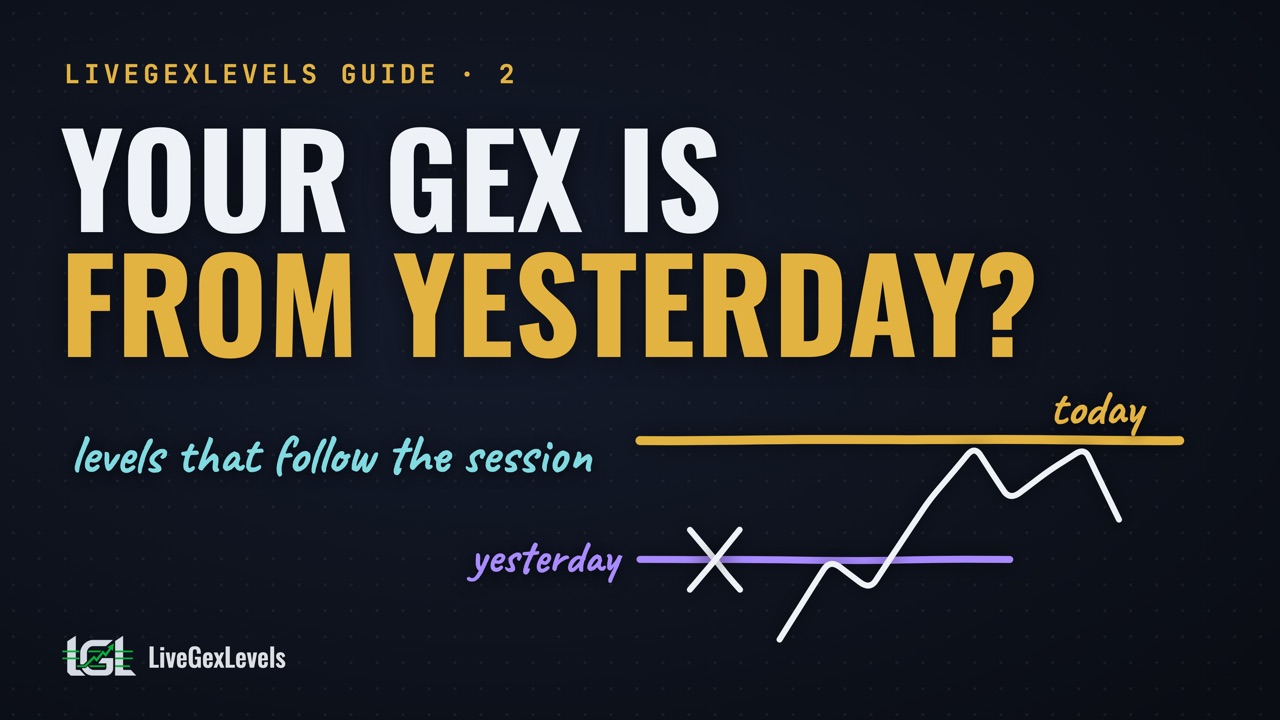
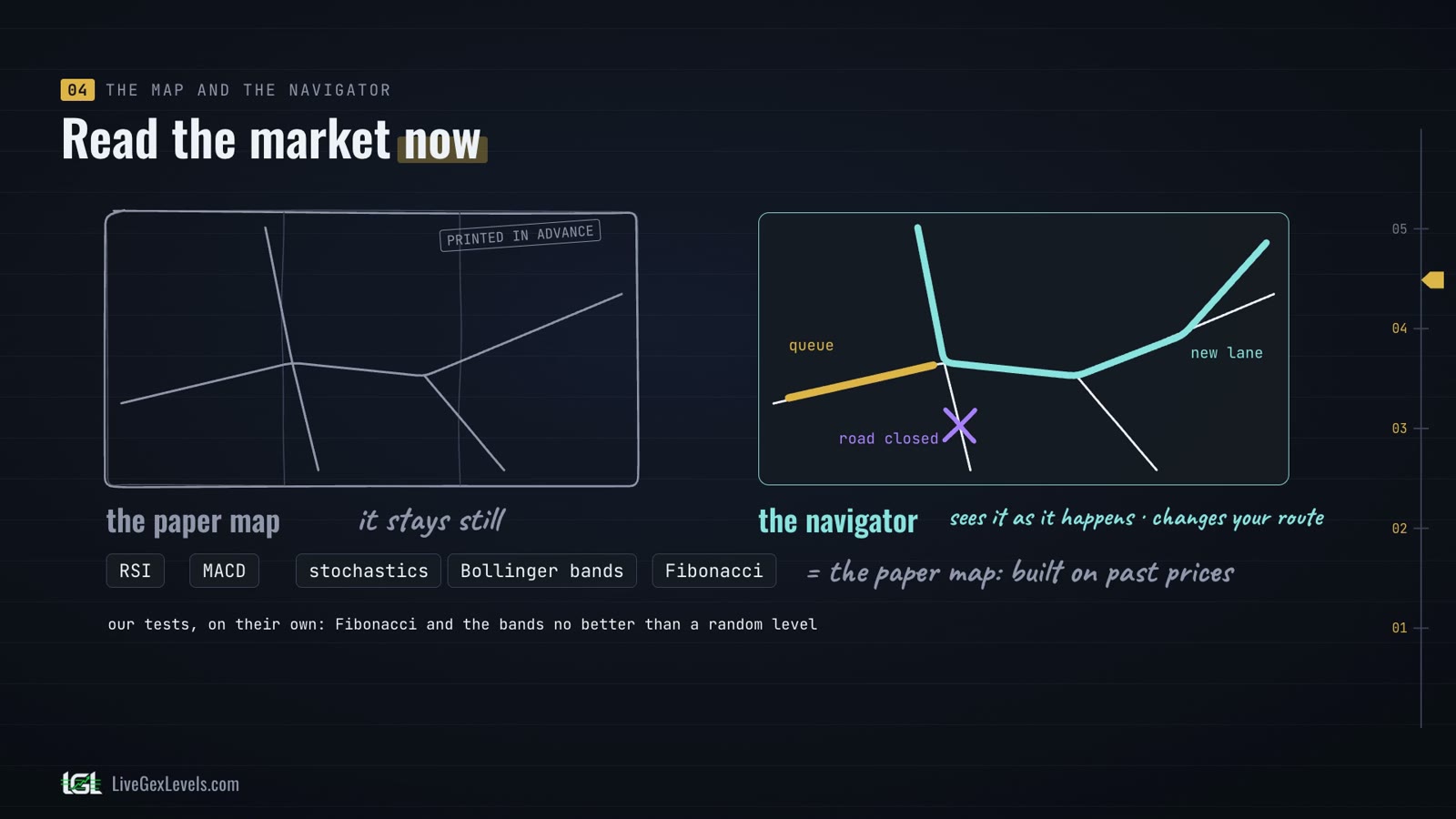
Why read the market now, and not as it was yesterday? Picture driving to an important meeting with a paper map, printed in advance. The map is still. It doesn't know that a road was closed this morning, that there's a queue on the ring road, that a new lane has just opened. A navigator sees all of it as it happens, and changes your route.
Indicators like RSI, MACD, stochastics, Bollinger bands and Fibonacci are built on past prices: they're the paper map. In our tests, Fibonacci and the bands, on their own, did no better than a random level.
Even standard GEX levels can be a paper map. They're computed from open interest, which is published once a day, with yesterday's positions. During the session the price moves, but those positions stay frozen: they don't see what's being opened and closed right now. So yesterday's wall may be gone today, and a new one may have formed where there was nothing.
That's why our levels are called LGL, and not just GEX: they follow how the positioning changes during the session. Back to the opening question, then: one edge is paid for by fear, the other by attention. Which one is yours?
In brief
- Options have two real edges: selling fear, and reading the dealers during the session. With both you can lose money.
- Selling fear is calm, slow and modest: it takes real capital, and it needs protection against crashes.
- In the very short term, options are priced about right: selling same-day premium leaves about nothing after costs.
- Reading the dealers is fast, asks for attention and lives in the very short term: the levels have to follow the session.
- One edge is paid for by fear, the other by attention.
Sources
More from this series
Read next
See the levels live
Seeing where dealers have to hedge is information a chart alone doesn't give you. Your edge starts with preparation.
Card required; after the trial the subscription renews at the launch price. For educational purposes only, not financial advice.