Options School · Published
The long put: insurance on the index
Why is your house policy worth more after an earthquake in the region, even if your house is fine? Because the same cover now costs more. On the index that insurance against a fall exists too: it's called a put.
 Watch on YouTube · 7:58
What you buy
A put is the right to sell the underlying at a fixed price, the strike, by a date, the expiry. You pay for that right today: the premium. An index can't be bought or sold as such, so on an index the put settles in cash: at expiry you receive the difference between the strike and the index, if the index ends below the strike. Puts arrived in Chicago in 1977, four years after the calls.
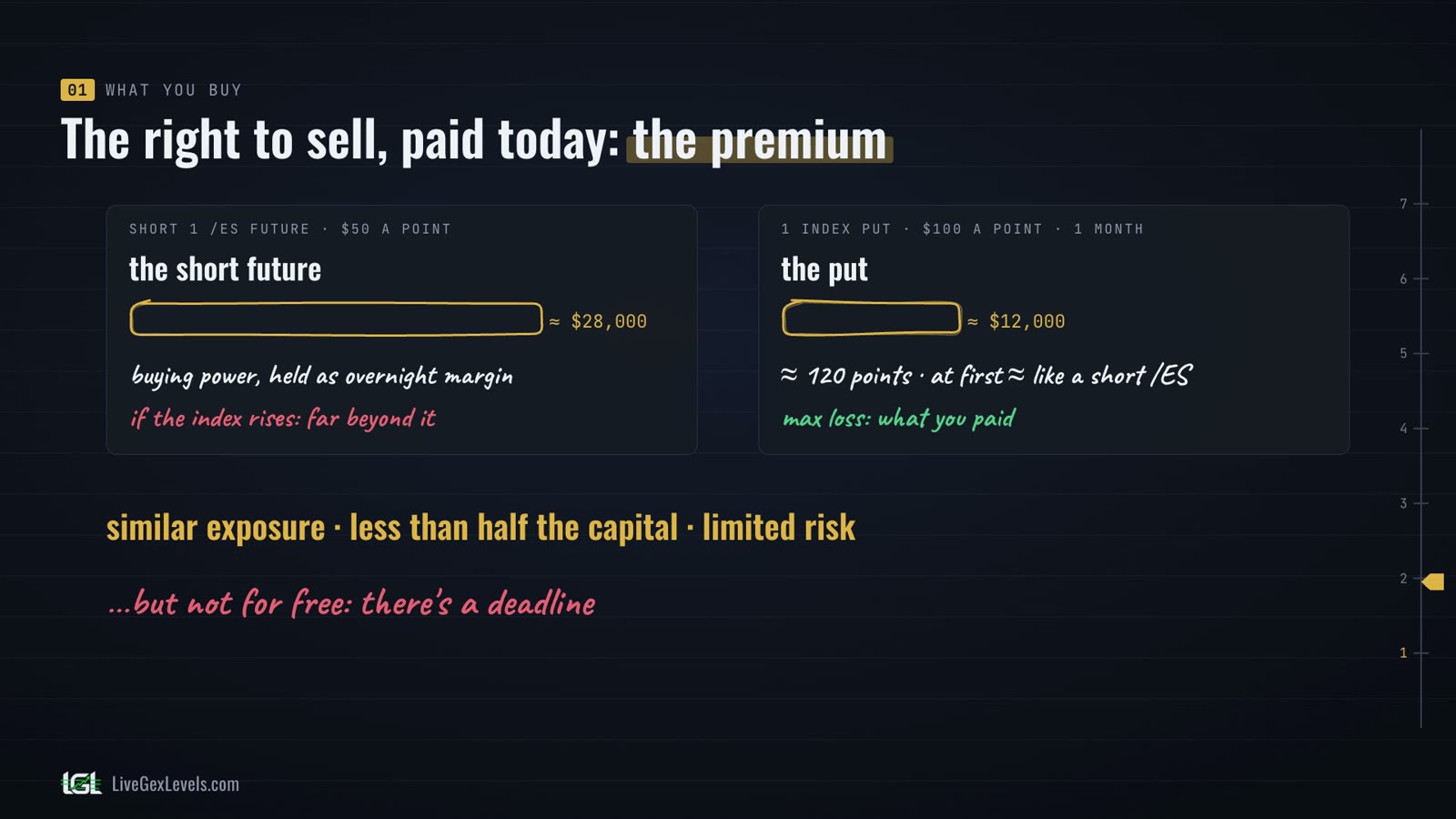
A comparison makes it concrete: betting on a fall with the S&P 500 future, ES. To go short one contract and hold it overnight, your broker blocks about 28,000 dollars of buying power, and if the index rises you can lose far more than that.
Now a put on the index, with example numbers: strike 7,800, where the index is, and a month to expiry. It costs 120 points, about 12,000 dollars, and at first it moves almost like that short future. Similar exposure, less than half the capital, and the most you can lose is what you paid.
It doesn't come for free, though: if at expiry the index isn't below the strike, the put is worth zero.
At expiry: the stick, reversed
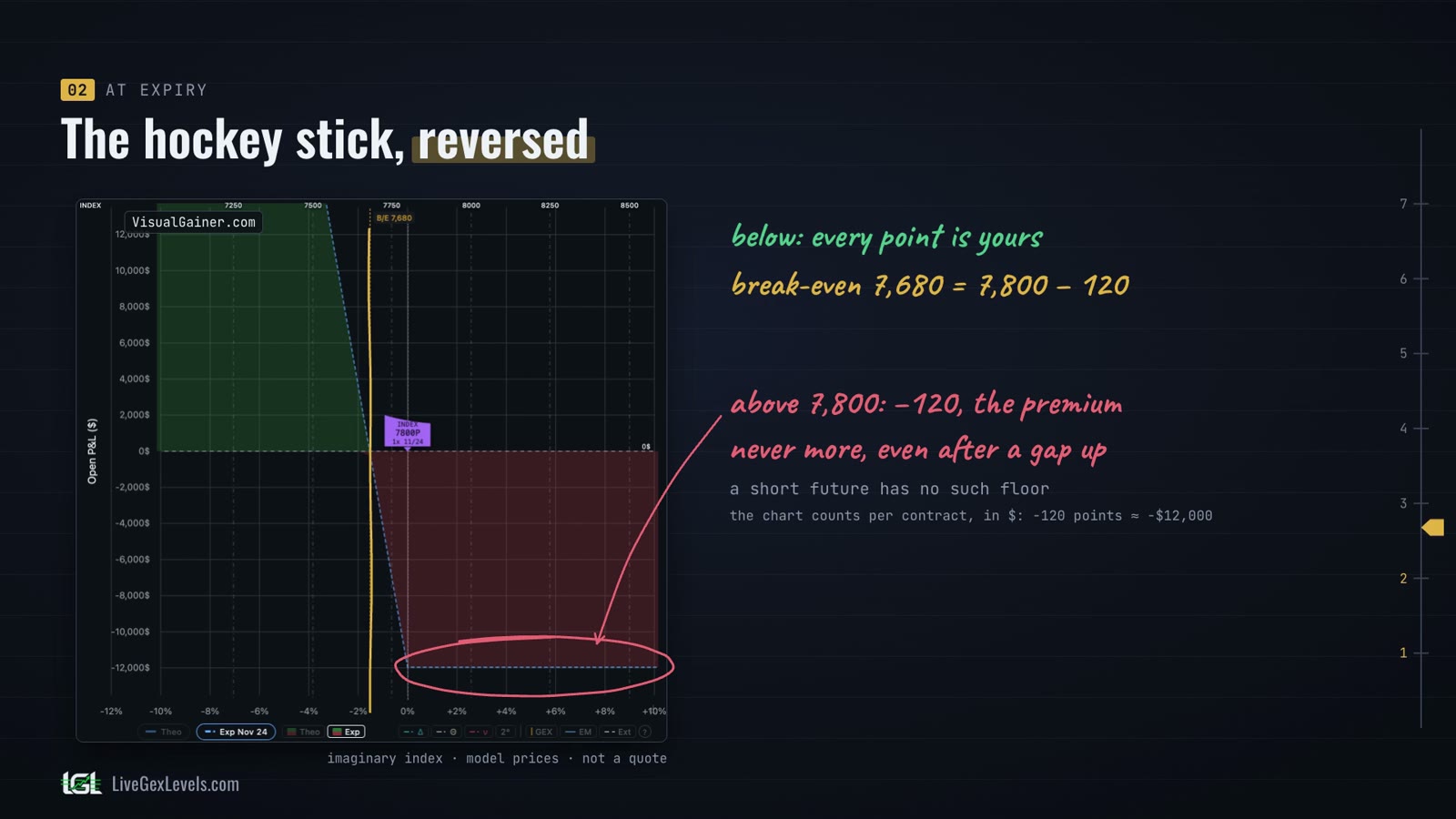
At expiry it's simple. If the index closes above 7,800, the put is worth nothing: you lose the premium, never more, even after a big gap up. A short future has no such floor.
Below 7,800, every point the index loses is a point for you. You break even at 7,680, the strike minus the premium. It's the hockey stick again, reversed: the handle rises to the left.
Before expiry: a young policy
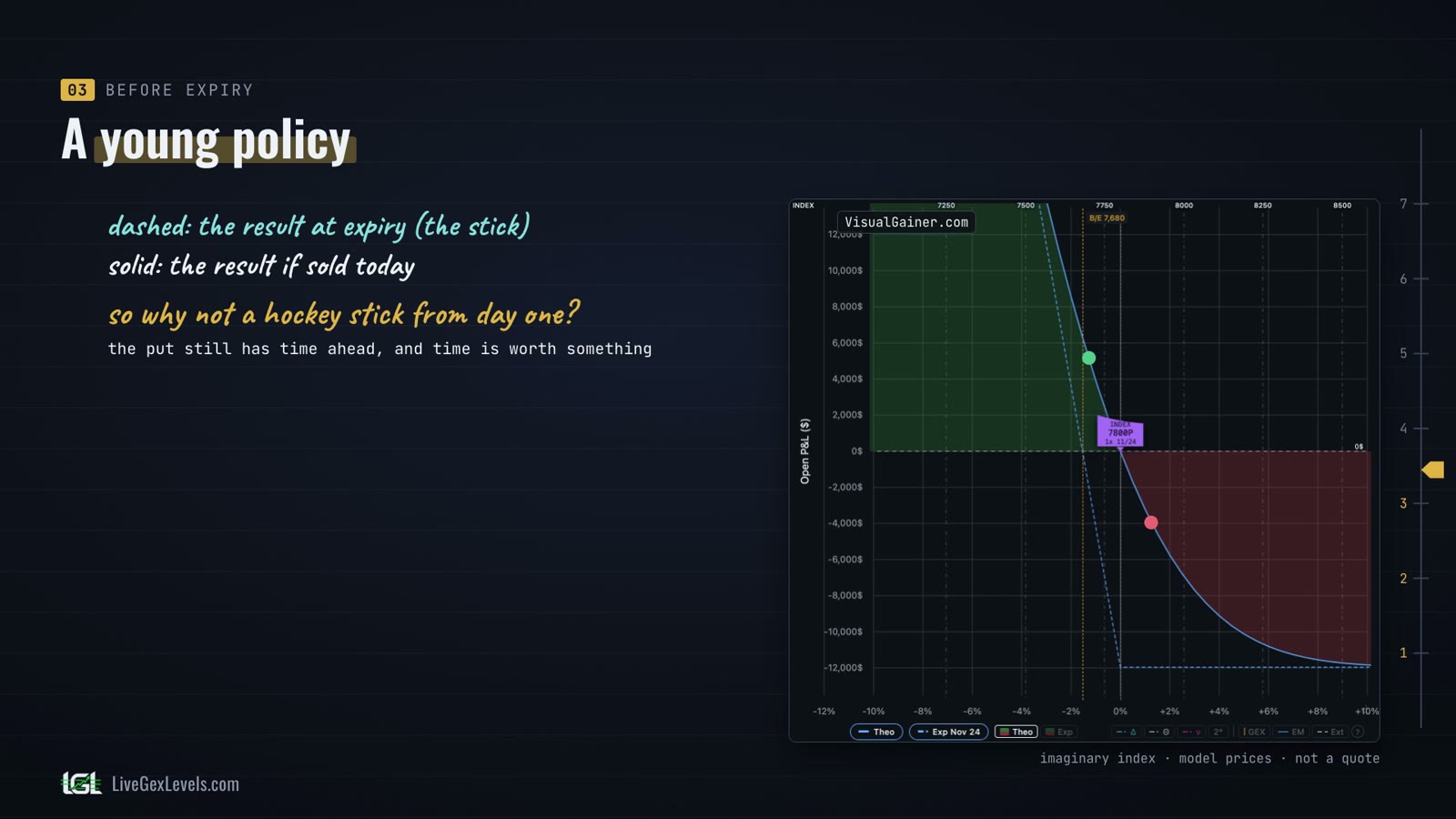
Before expiry, as with the call, the curve is softer. It shows the result if you sold the put today. Right after you buy it, the put is worth what you paid, so the result is zero. If the index falls to 7,700, it's worth about 171, more than you paid; if it rises to 7,900, about 80, less. However far the index rises, the put can't be worth less than zero: you never lose more than the premium.
So why isn't the curve a hockey stick from day one? Because the put still has time ahead of it, and time is worth something. Its price has two parts. The intrinsic value: what it would pay if it expired now, the strike minus the index, or zero. And the time value: the rest. At 7,800 the put would pay nothing, so all 120 points are time value. That's what keeps the curve above the stick, on both sides of the strike.
Back to the house insurance. Sold with a year of cover left, a policy could cover someone else for a long time, so it's still worth a lot. The day before it ends, there's no time left for anything to happen, and it's worth almost nothing. Like the call, the put can be sold on any trading day.
Let time pass with the index still at 7,800: after twenty days the put is worth about 72, two days before expiry about 34, and the curve settles onto the stick.
The greeks of the put
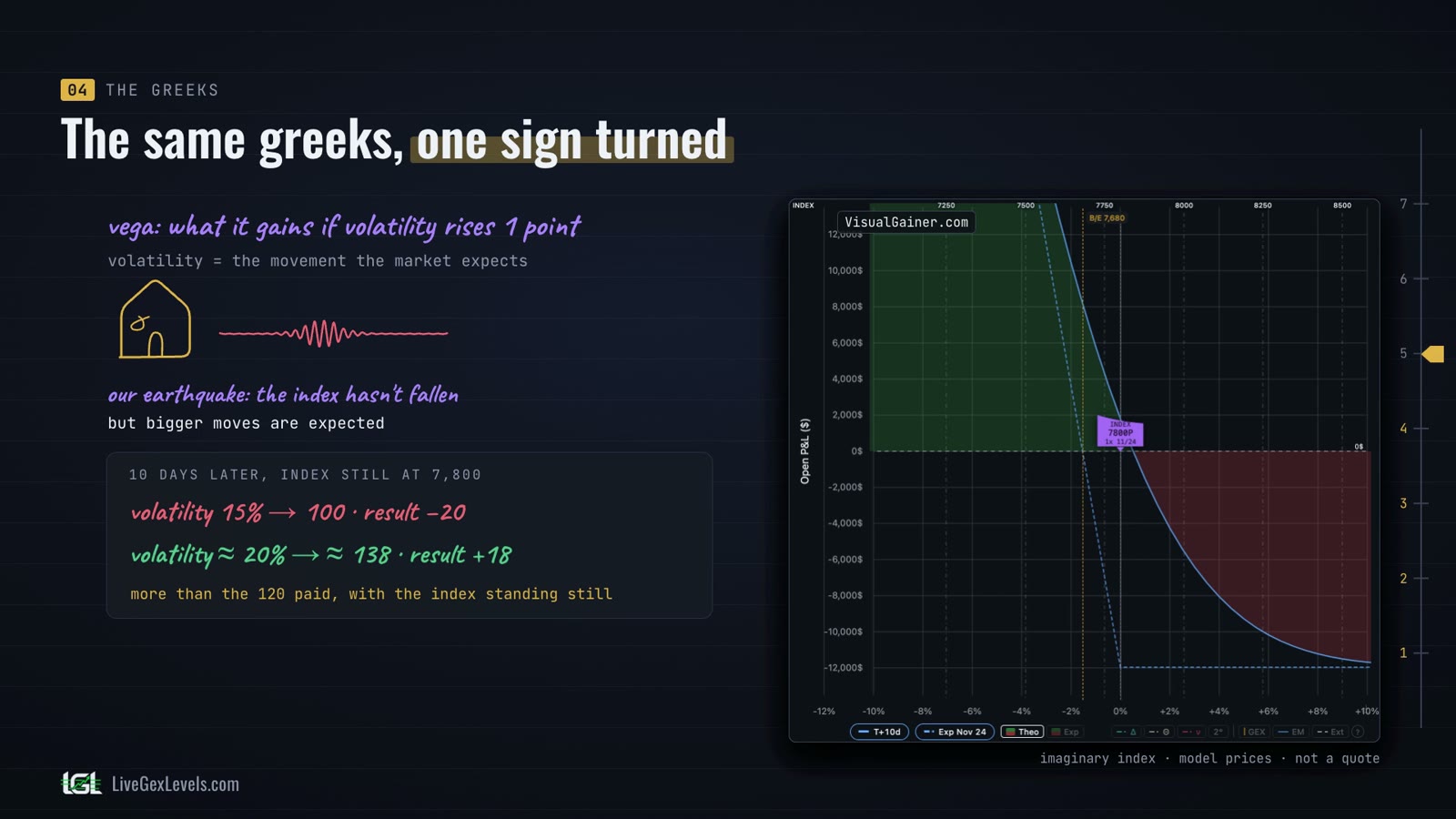
The greeks work as they do for the call, with one sign turned around. Delta is negative: here, minus 0.46, so for every point the index falls, the put gains almost half a point.
Gamma is still on your side: on a 100-point fall the put gains 52, on a 100-point rise it loses only 40. Theta still costs you every day, and faster near expiry.
Then vega: how much the put gains when volatility, the movement the market expects, rises one point. It's the earthquake: the index hasn't fallen, but bigger moves are expected. Ten days after buying, with the index standing still, the put is worth 100 if volatility stayed at 15%. If volatility rose to about 20%, it's worth about 138: more than the 120 you paid.
On the index, volatility amplifies
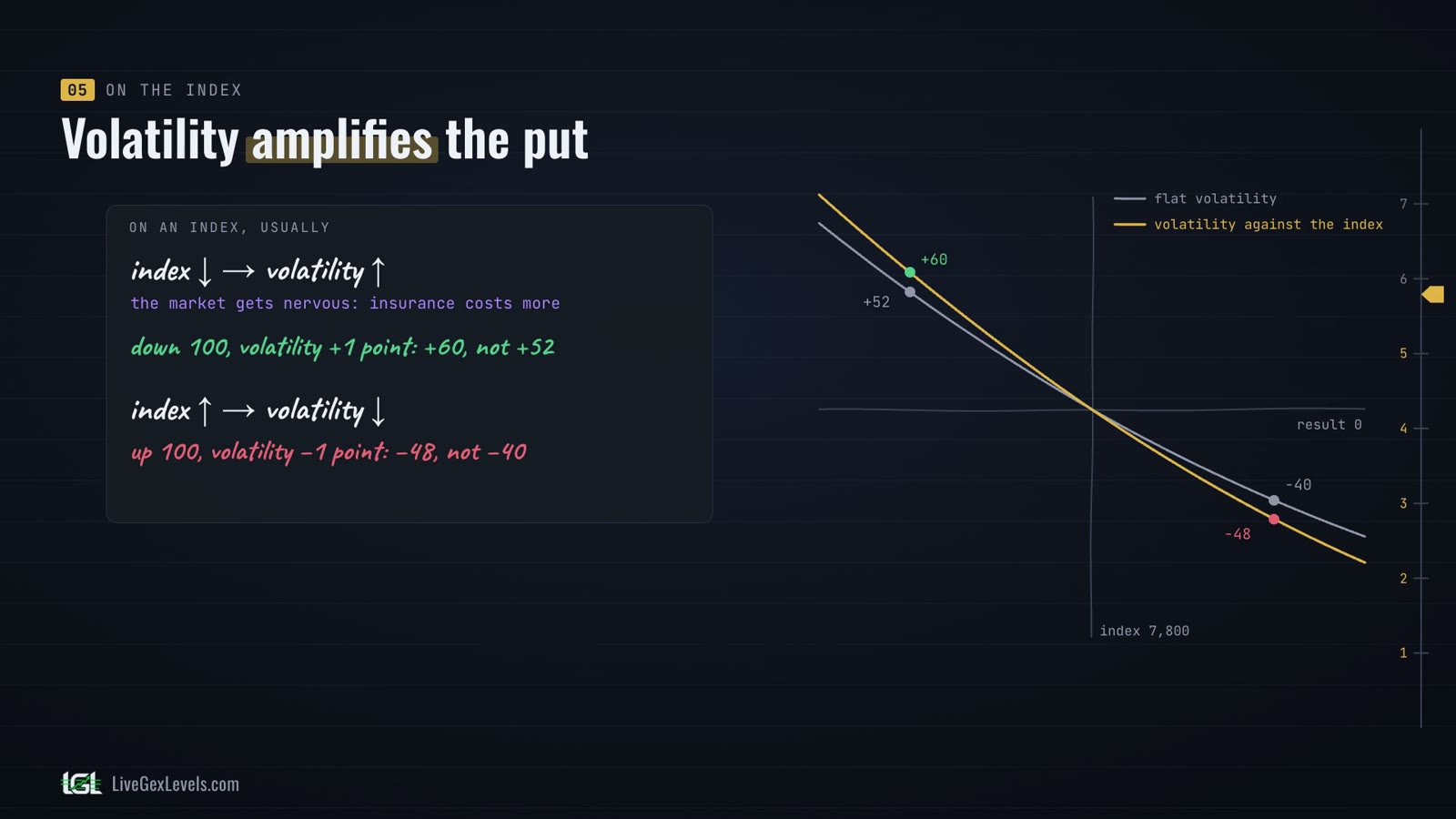
Here is what makes the put on an index special. When the index falls, volatility usually rises: the market gets nervous, and insurance costs more. So on a 100-point fall the put gains more: 60 instead of 52.
When the index rises, volatility usually falls, and the put loses more: 48 instead of 40. For the call, the index's volatility worked like a brake. For the put, it amplifies: bigger gains, and bigger losses.
Protection and the bet on the fall
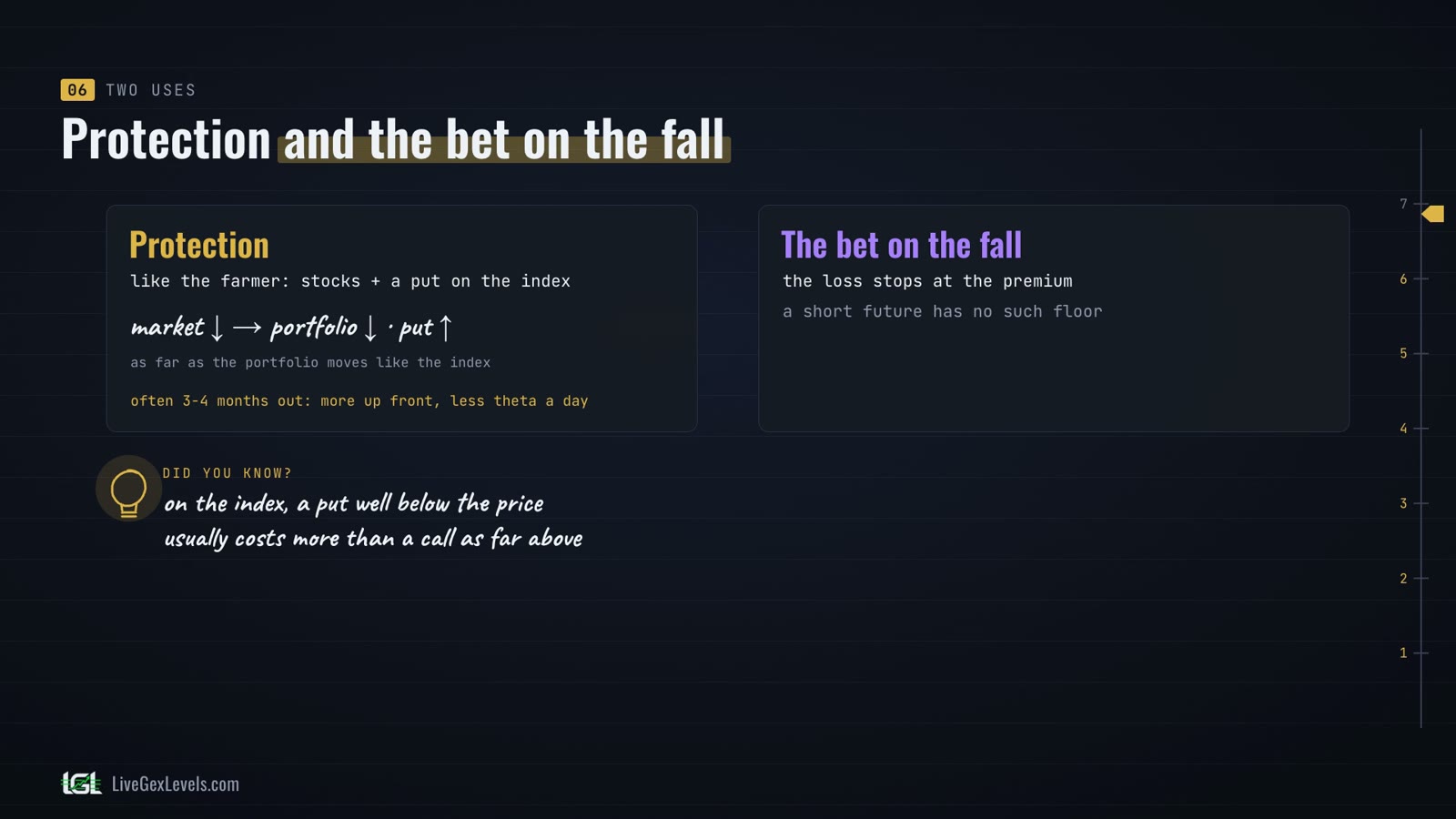
So who buys puts? First, those who want protection, like the farmer from the first episode: whoever holds stocks can buy a put on the index, and if the market falls, the put gains while the portfolio loses. Since theta speeds up near expiry, many who protect a portfolio buy puts three or four months out: more up front, but much less per day.
Second, those who bet on the fall, with the loss limited to the premium, unlike a short future.
One thing to know: on the index, a put with its strike well below the price usually costs more than a call with its strike just as far above. The market prices it with a higher volatility, and that's called skew: insurance against the fall costs more.
In brief
- A put is a leveraged bet on the fall, or a protection, with a deadline, and the loss stops at the premium, even after a gap.
- At expiry it's the hockey stick reversed: the handle rises to the left.
- Before expiry the curve is softer: the stick plus the time value.
- Delta is negative, theta costs every day, and vega is the earthquake.
- On the index, volatility amplifies the put: it gains more on the way down, and loses more on the way up.
Sources
More from this series
Read next
See the levels live
Seeing where dealers have to hedge is information a chart alone doesn't give you. Your edge starts with preparation.
Card required; after the trial the subscription renews at the launch price. For educational purposes only, not financial advice.