Options School · Published
Call options explained: the long call, its payoff and the Greeks
Pay a fraction of an index's value today to gain on every point it rises above a price fixed now: a leveraged bet on the rise, with a deadline. But to win it, being right isn't enough: the rise has to come, big enough, and in time.
 Watch on YouTube · 12:55
What you buy
The first options listed in Chicago, in 1973, were all calls; puts arrived four years later. A call is the right to buy the underlying at a fixed price, the strike, by a date, the expiry. You pay for that right today: the premium.
An index can't be bought as such, so on an index the call is settled in cash: at expiry you receive the difference between the index and the strike, if the index ends above the strike.
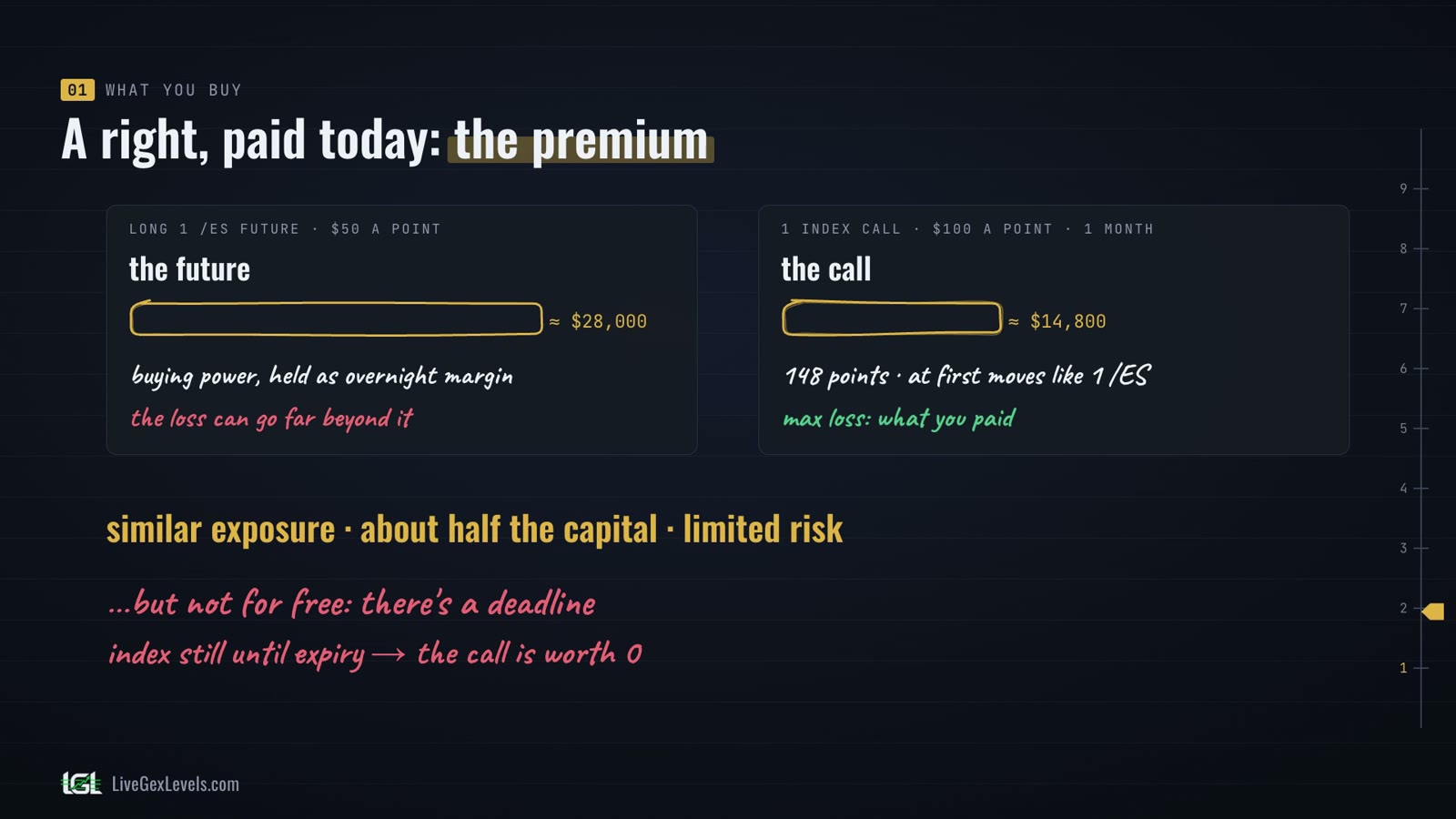
A concrete case: the S&P 500 future, ES. To hold one contract overnight your broker blocks about 28,000 dollars of buying power, and a fall can cost you far more than that. A call on the index, with example numbers, strike 7,800, where the index is, and a month to go, costs 148 points, about 14,800 dollars, and at first moves much like that future.
Similar exposure, about half the capital, and the most you can lose is what you paid. But it doesn't come for free: the call has a deadline, and if the index stands still until expiry, it's worth zero.
At expiry: the hockey stick
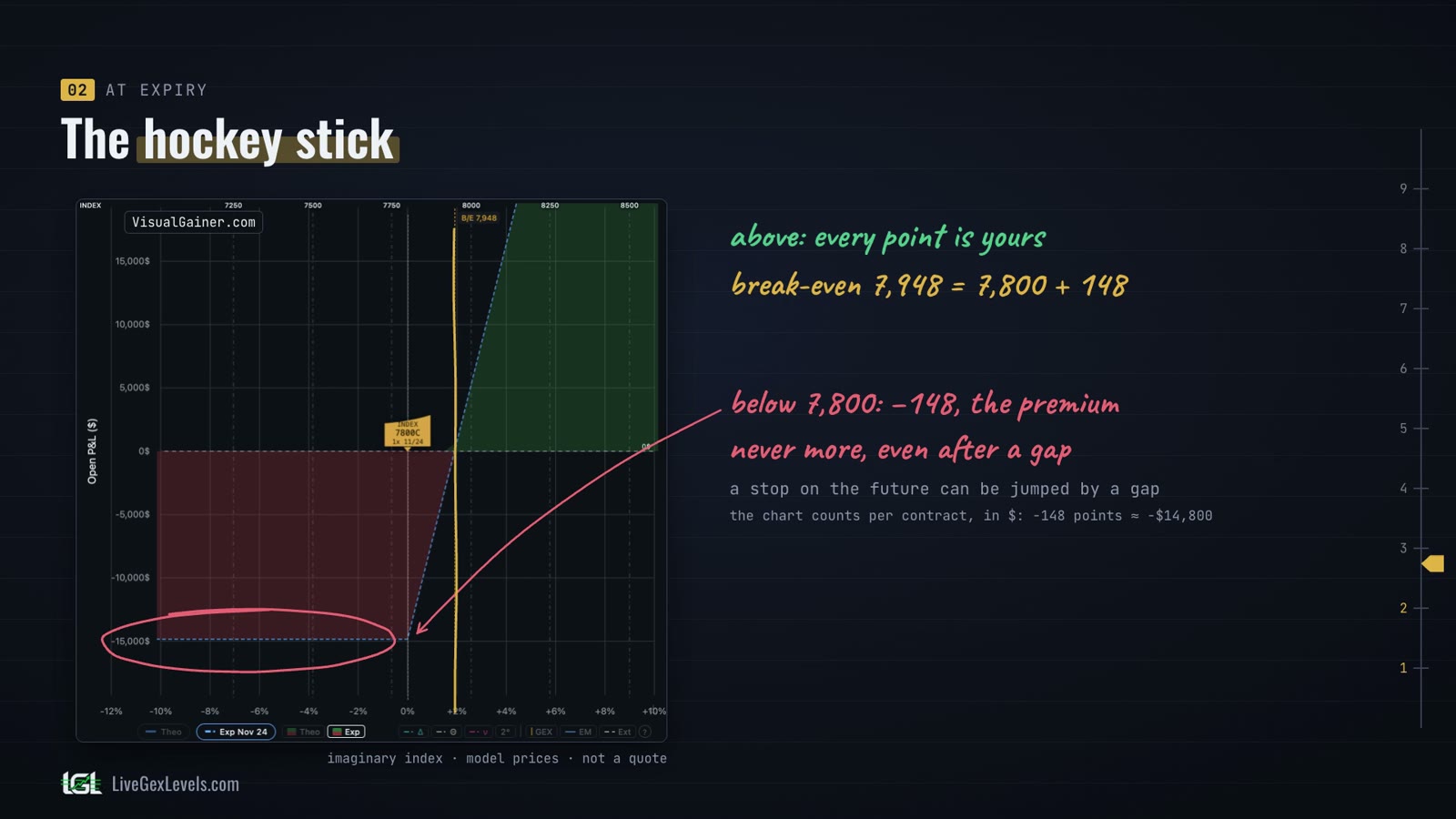
Start from the end: the day it expires. If the index closes below 7,800, the right is worth nothing and you've lost the premium. Only the premium, never more, even if the index opens with a big gap down. A stop on the future can't promise that: a gap can jump right over it.
Above 7,800, every point the index gains is a point for you. You break even at 7,948, the strike plus the premium. That's the shape at expiry: flat, then a straight line up. Traders call it the hockey stick.
Before expiry: a softer curve
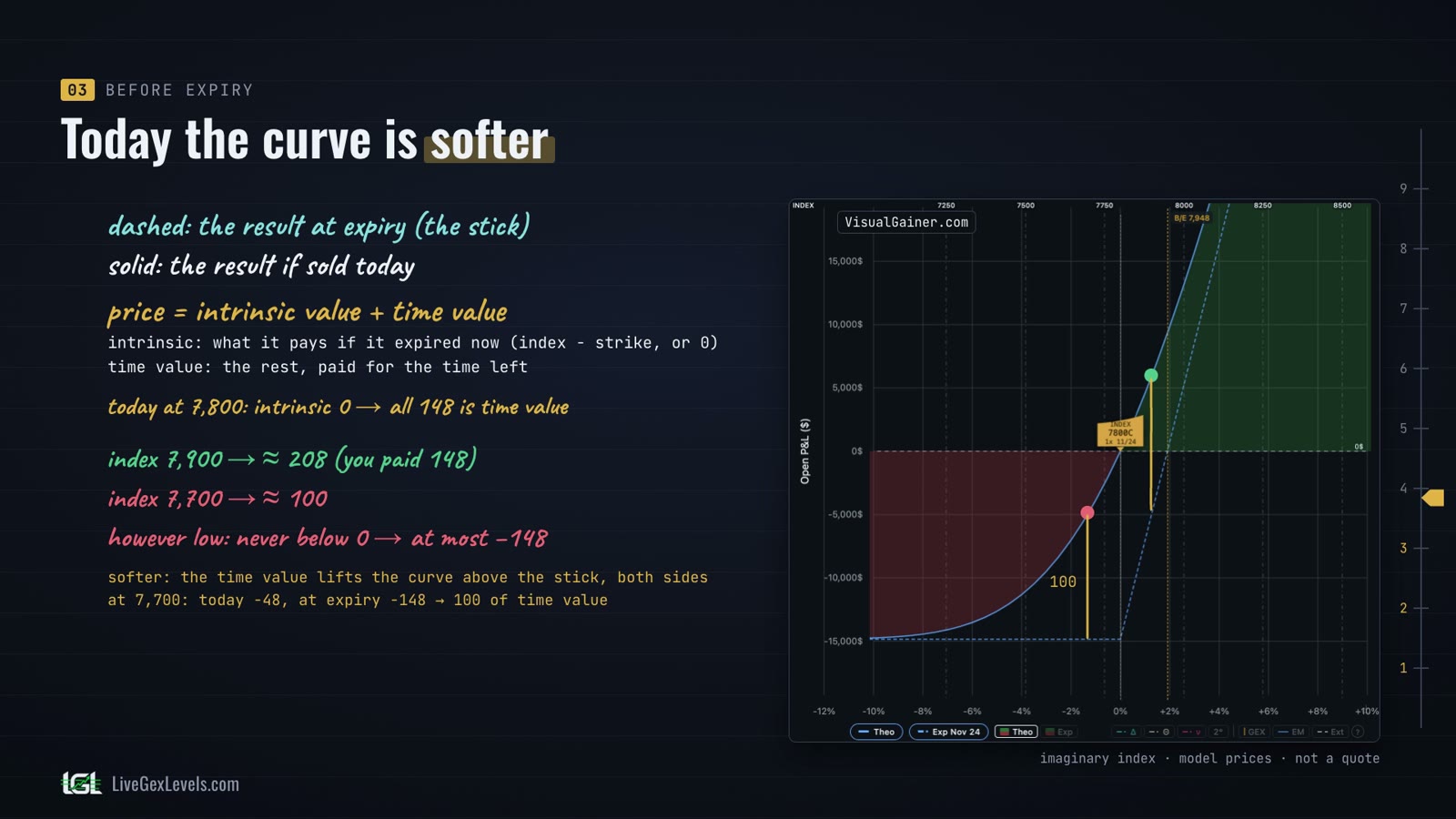
Before expiry the picture is different. On the chart the dashed line is the stick, the result at expiry; the solid one is the result if you sold the call today. Right after you buy it, it crosses zero at 7,800: sell it back at once and you get about what you paid, leaving the bid-ask spread aside.
Why isn't the curve a hockey stick from day one? Because the contract still has time ahead of it, and time is worth something. Say you pay 5,000 euros today for the right to buy a flat at 300,000 within a year. If a month later flats like it sell for 330,000, your right is worth at least 30,000. If prices are still at 300,000, it's still worth something: there are eleven months left for them to rise. With one week left, it's worth almost nothing.
A call works the same way. Its price has two parts: the intrinsic value, what it would pay if it expired right now, the index minus the strike, or zero; and the time value, the rest, paid for the time left. At 7,800 the intrinsic value is zero: all 148 points are time value.
If the index rises to 7,900, the call is worth about 208 points; if it falls to 7,700, about 100, and however far it falls you never lose more than the 148 you paid. At 7,700 those 100 points are all time value: selling today you'd lose only 48, at expiry all 148. The lift is greatest near the strike, where the index could still go either way.
Now let time pass, with the index still at 7,800. After ten days the call is worth 119; after twenty, 82; two days before expiry, 35. Like the flat with one week left, there's little time for anything to happen: the time value melts, and the curve settles onto the stick.
You can get out before
You don't have to wait for expiry. You can sell the call at any time while the market is open, at the price buyers are paying. On contracts that trade little, that price can sit well below the curve.
American or European: the only difference is which days you can exercise. An American option can be exercised on any trading day; a European one, like SPX options, only at expiry. Selling works the same for both.
And exercising early usually gives up the time value. Say the index is at 7,900 with ten days left, and the call is American. Exercise it and you get the 100 points above the strike; sell it and you get about 145.
Delta and gamma
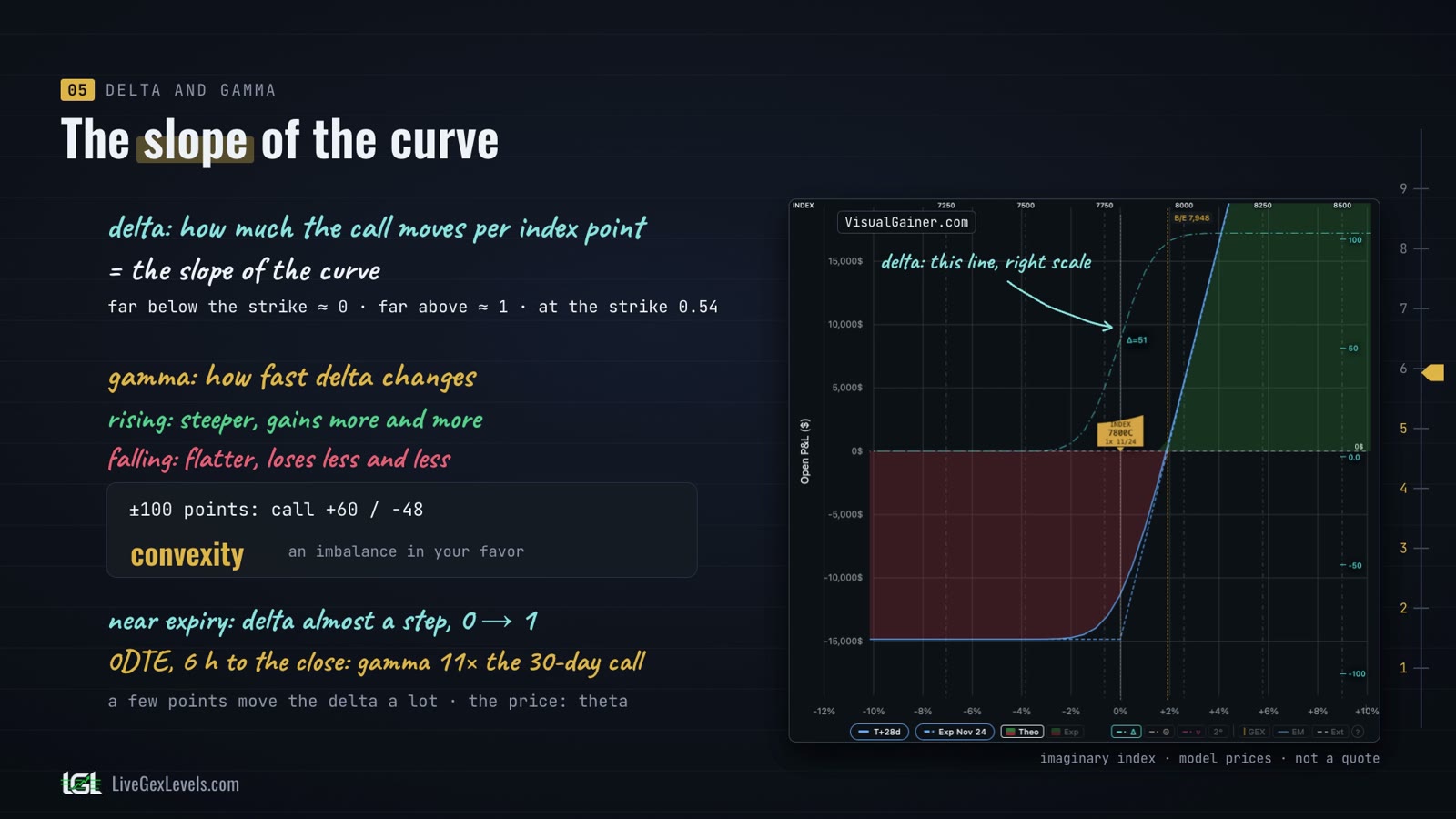
Now the three numbers that move the call. The first is delta: how much the call moves when the index moves one point. It's the slope of the curve. Far below the strike it's close to zero, far above it's close to one, and at the strike it's a little over one half: here, 0.54.
The slope itself changes as the index moves, and that change has a name: gamma. As the index rises the curve gets steeper and the call gains more and more; as it falls the curve flattens and the call loses less and less. With 100 points either way, the call gains 60 but loses only 48. That imbalance in your favour is called convexity.
Time sharpens it. Near expiry, delta turns almost into a step: zero below the strike, one above. On a 0DTE, an option that expires the same day, with six hours to go, gamma is 11 times higher than at 30 days, and it keeps climbing. That's what draws scalpers: a few points are enough to change the delta a lot. The price is time.
Theta: the cost of time
The second number is theta: what one day costs. For our call, 2.7 points a day, almost 2% of its value. And it speeds up: with two days left, 9 a day, and on the last day time takes all that's left. It bites hardest near the strike, exactly where the time value is.
That's how you can be right about the direction and still lose. Take a call on the index that expires the same day, bought six hours before the close for 12.3. Four hours later the index is up 5 points, and the call is worth 9.9. The move came, but too slowly.
Vega: volatility
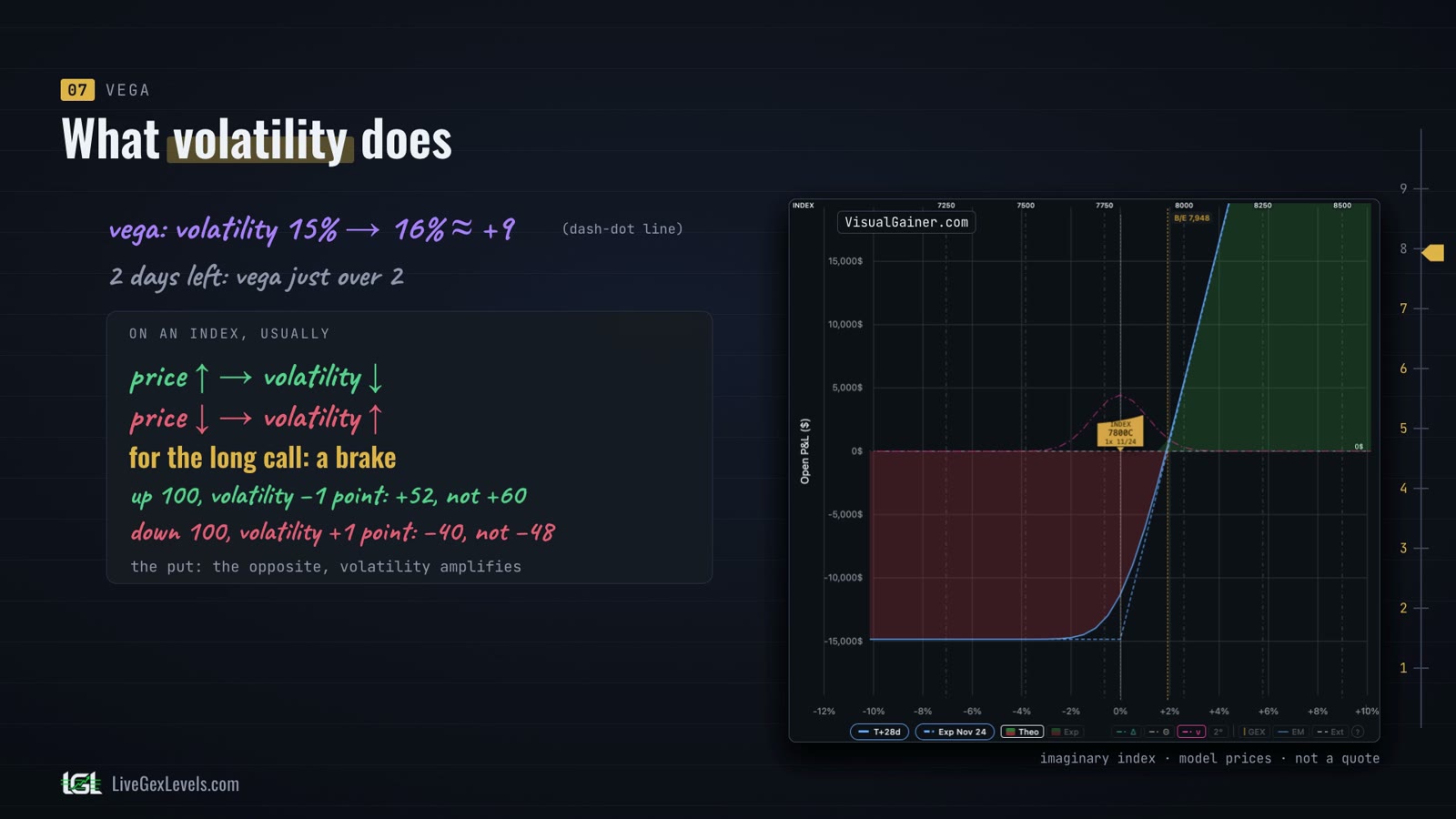
The third number is vega: how much the call gains when implied volatility, the movement the market expects, rises one point. Here implied volatility is 15%: at 16, the call gains almost 9 points.
Back to the flat. A big project comes to the neighbourhood, still uncertain: a metro station, or an incinerator. Prices could rise a lot or fall a lot, and nobody knows which way yet. Prices haven't moved, yet your right is worth more: a wider range of possible prices means bigger gains above the strike, while below it you still lose only the premium.
On the index, volatility tends to rise before big events, like a central bank decision. Ten days after buying, with the index still at 7,800, our call is worth 119: time has taken 29 points. But if volatility has risen from 15 to about 20% in the meantime, it's worth about 157, more than the 148 you paid, with the index standing still.
Vega shrinks with time too: two days before expiry, it's just over 2. And on an index there's a catch: volatility usually falls when the price rises, and rises when the price falls. For a long call it works like a brake: on the way up it gains a little less, on the way down it loses a little less. With the put it's the opposite: volatility amplifies. Time and volatility both work against anyone who buys a call for a slow rise.
Scalping and LEAPS
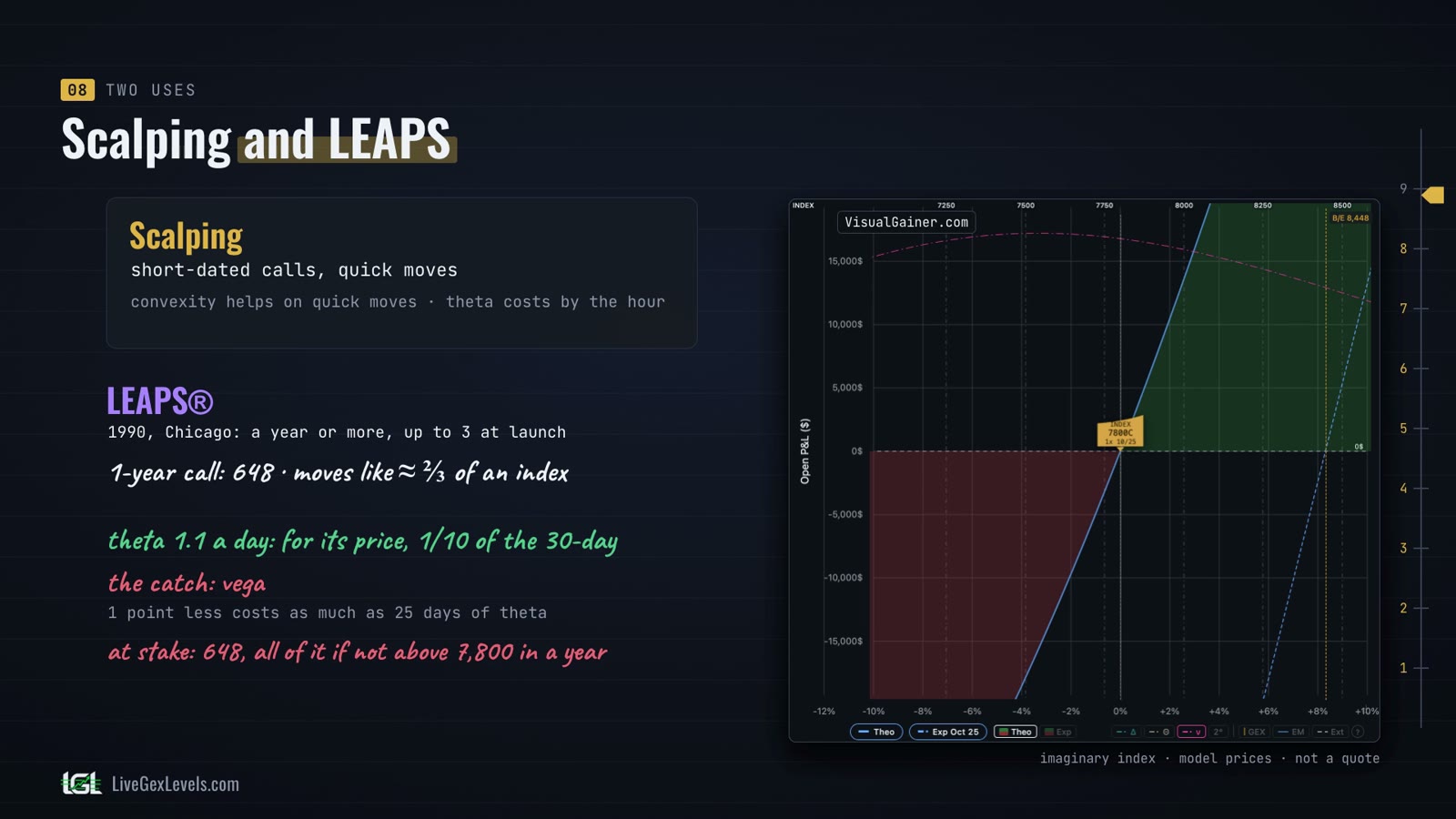
So who buys calls, and how? Two very different ways. Scalpers buy short-dated calls for quick moves: convexity works for them, and the price they pay is theta, by the hour.
At the other end there are LEAPS, created by the Chicago options exchange in 1990: options that last a year or more, up to three at launch. A one-year call on our index costs 648 points and moves like about two thirds of an index. Since theta speeds up only near expiry, it loses just 1.1 points a day: for its price, a tenth of the 30-day call.
The catch is vega: one point less of volatility costs it as much as 25 days of time, even with the index standing still. And more is at stake: 648 points, all lost if in a year the index isn't above the strike.
In brief
- A call is a leveraged bet on the rise, with a deadline, and the loss stops at the premium, even after a gap.
- At expiry it's a hockey stick; before that, a softer curve: the stick plus the time value, which melts as time passes.
- You can sell it on any trading day, at the market price.
- Delta tells you how it moves, theta what each day costs, and vega what volatility does to its price.
- Being right isn't enough: the rise has to come, big enough, and in time.
Sources
More from this series
Read next
See the levels live
Seeing where dealers have to hedge is information a chart alone doesn't give you. Your edge starts with preparation.
Card required; after the trial the subscription renews at the launch price. For educational purposes only, not financial advice.