Options School · Published
The short call: covered call and collar
On its own, the short call is the most feared position in options, yet it sits inside one of the strategies investors use most. How? With the shares underneath, a loss without a ceiling becomes a ceiling on the gain.
 Watch on YouTube · 8:58
The other side of the call
Start with the concert ticket from the last episode, reserved at 50: the right to buy it. Now you're the one who sold that reservation, without owning a ticket. You collect a small fee straight away, and in exchange you take on an obligation: if the buyer wants the ticket, you must hand it over at 50, whatever it costs by then. That's the short call: the call from the second episode, seen from the side that sells it.
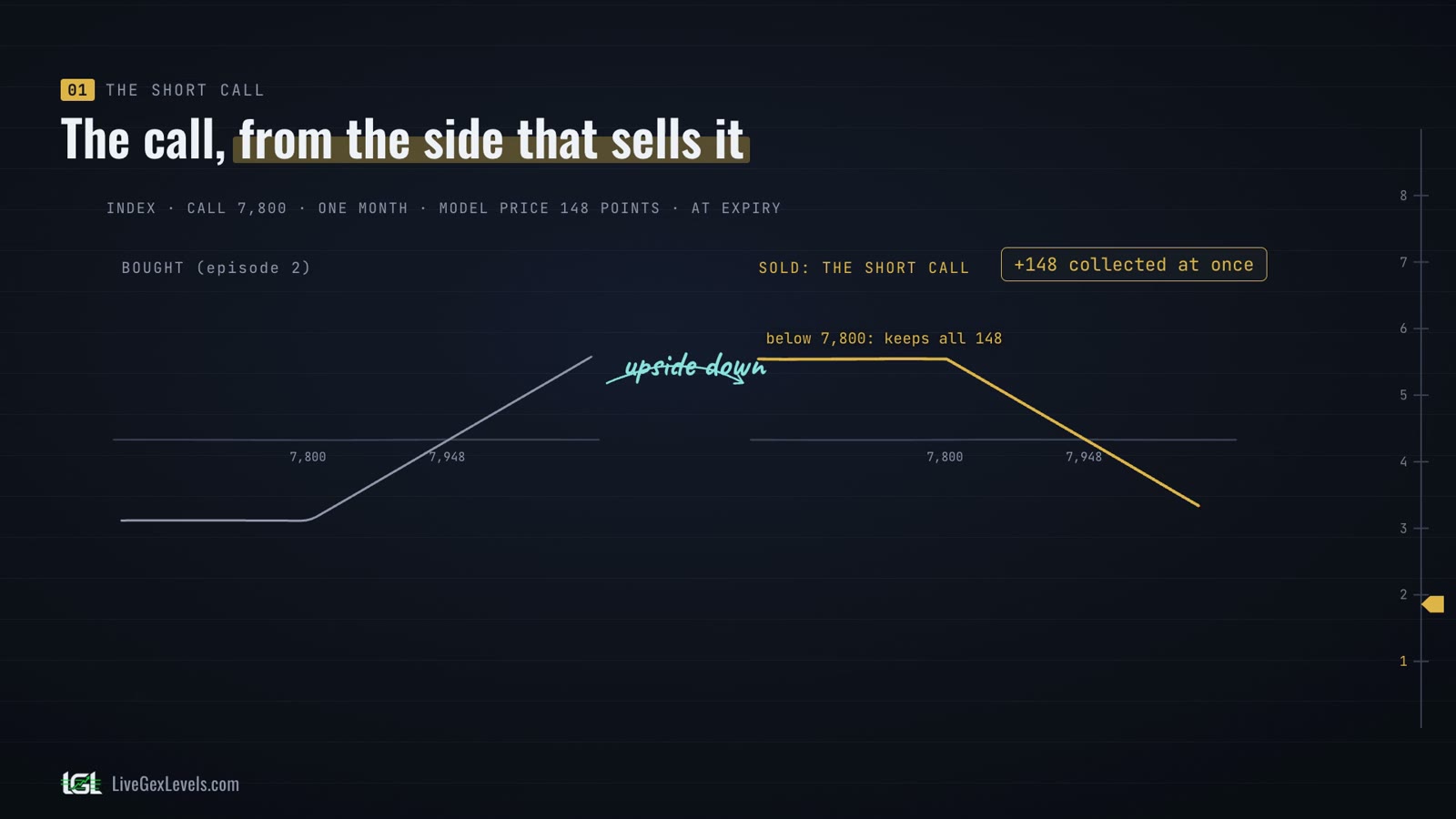
On the index the case is the same. Take the call at 7,800, a month out, that cost 148 points: whoever sells it collects those 148 points at once. At expiry the seller's result is the buyer's, upside down.
If the index ends below 7,800, the call is worthless and the seller keeps everything. Above it, every point the index rises is a point the seller pays: at 7,948 he's back to zero, and further up the loss keeps growing.
Why it's feared
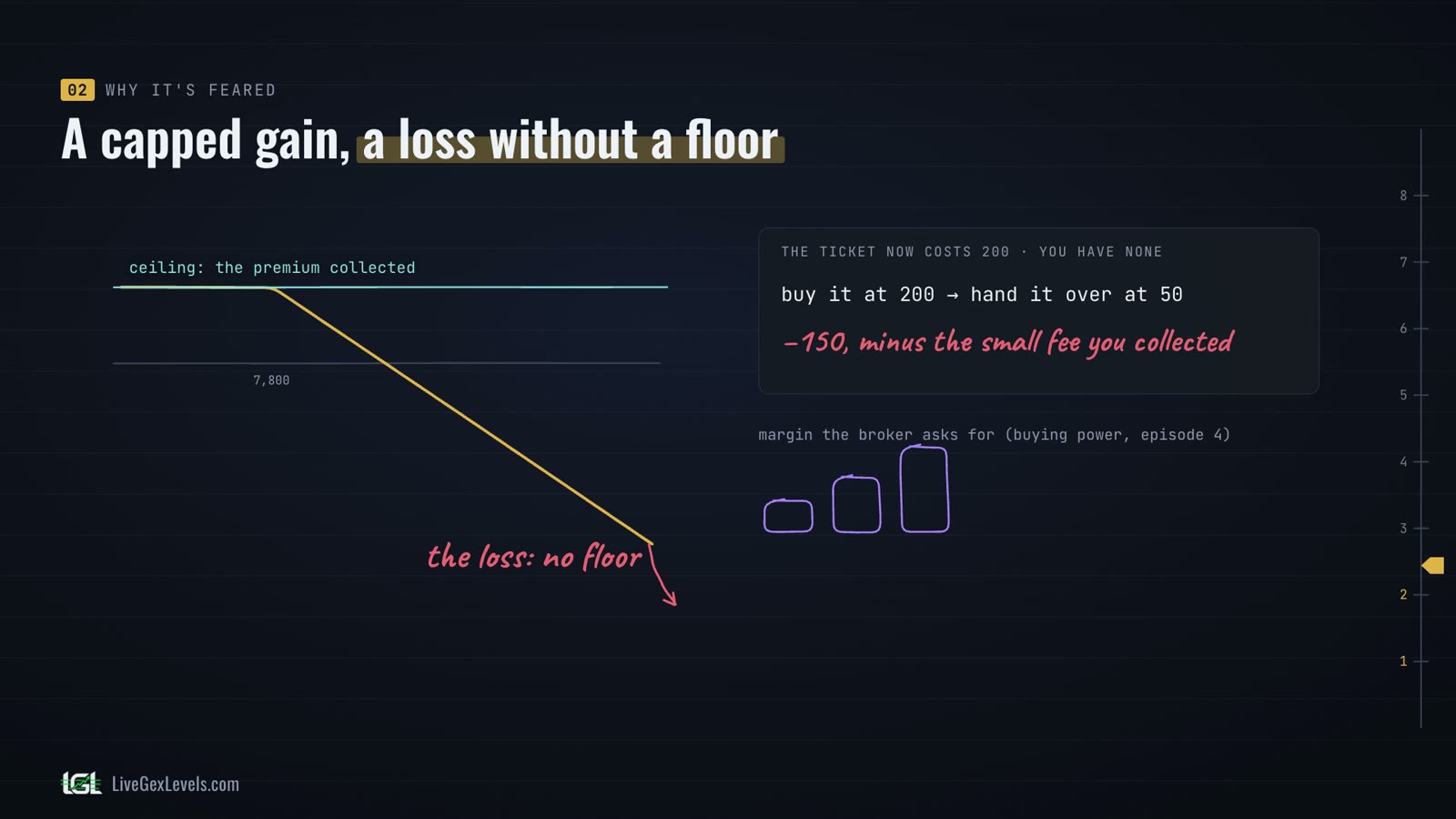
The gain has a ceiling: at most, the premium collected. The loss doesn't: in theory the price can keep rising without limit, and so can what you owe. With the ticket: if it ends up costing 200 and you don't have one, you have to buy it at 200 to hand it over at 50.
And while the price rises, the broker asks you for more and more margin: the buying power seen in the last episode.
It has happened for real. In November 2018 an American firm, OptionSellers, ran its clients' accounts by selling call options on natural gas, uncovered: a bet that gas would stay cheap. In a few days the price jumped. The broker closed the accounts, and some clients lost more than they had deposited: they ended up owing money.
Why sell it anyway
So why does anyone sell calls? Because of time value. In the last episode, whoever exercised early threw it away; here is who collects it: the seller. The call at 7,800 was all time value, 148 points. If the index doesn't move, at expiry those 148 points belong to the seller: time works for him, a little every day.
The danger is the uncovered rise. So what if you already owned what you might have to deliver?
The covered call
Back to the ticket. If you already own one, the rise no longer scares you: if the buyer wants it, you hand over yours. At most you give up what it would be worth above 50. That's the covered call: you own the shares, and you sell a call on them.
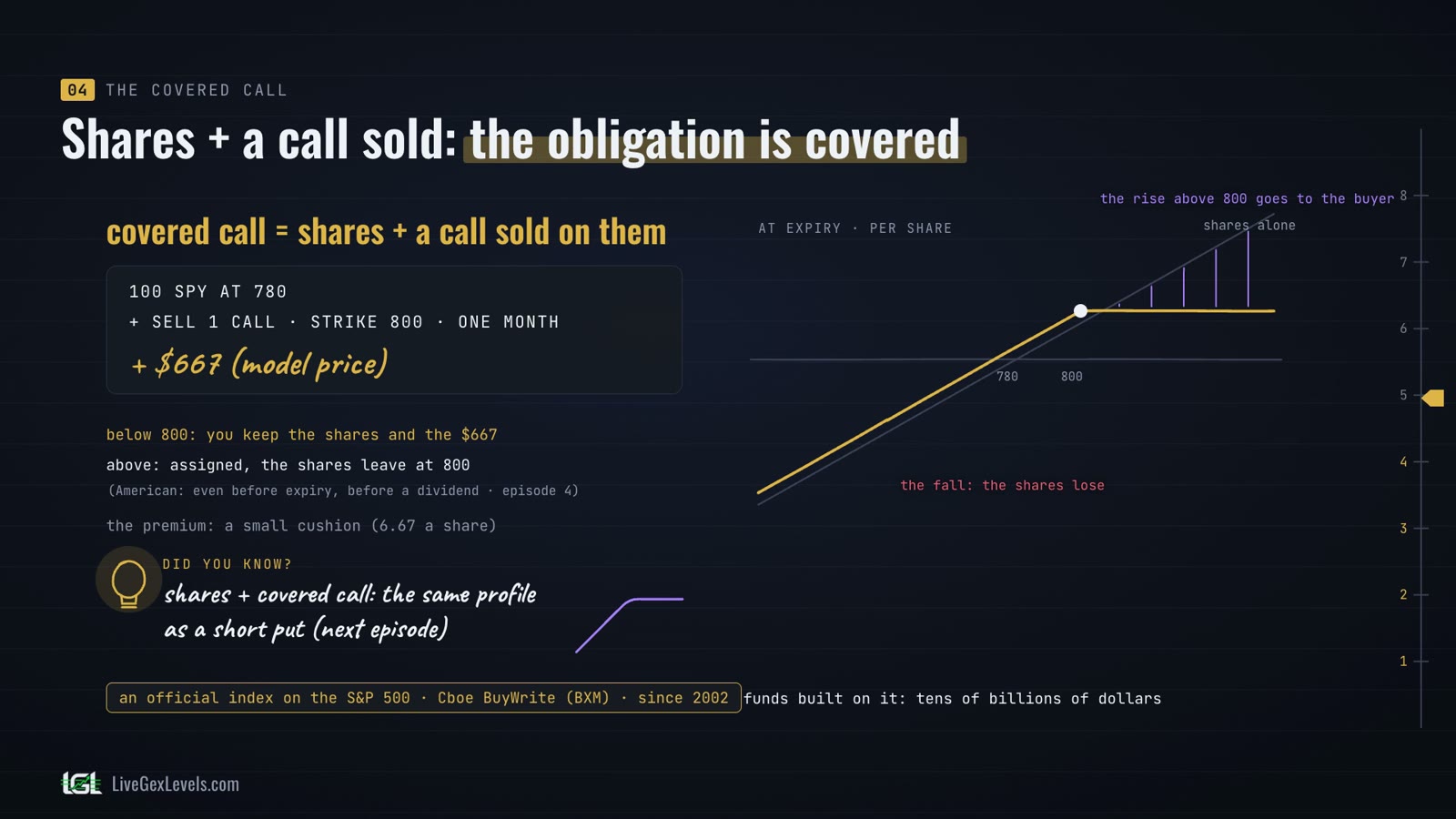
Take 100 shares of SPY at 780 and sell one call with strike 800, a month out: the model gives you 667 dollars. If SPY stays below 800, you keep the shares and the 667 dollars. If it ends above, you're assigned: the shares leave your account at 800, even before expiry if there's a dividend, as in the last episode. You earn up to 800, plus the premium, and everything above goes to the buyer.
And if SPY falls? The shares lose, just as they would without the call: the premium only softens the fall a little. A detail that's rarely said: shares with a covered call have the same profile as a short put, the subject of the next episode.
The strategy is so common that there's an official index of it on the S&P 500, the Cboe BuyWrite index, BXM, since 2002, and funds built on it manage tens of billions of dollars.
The collar
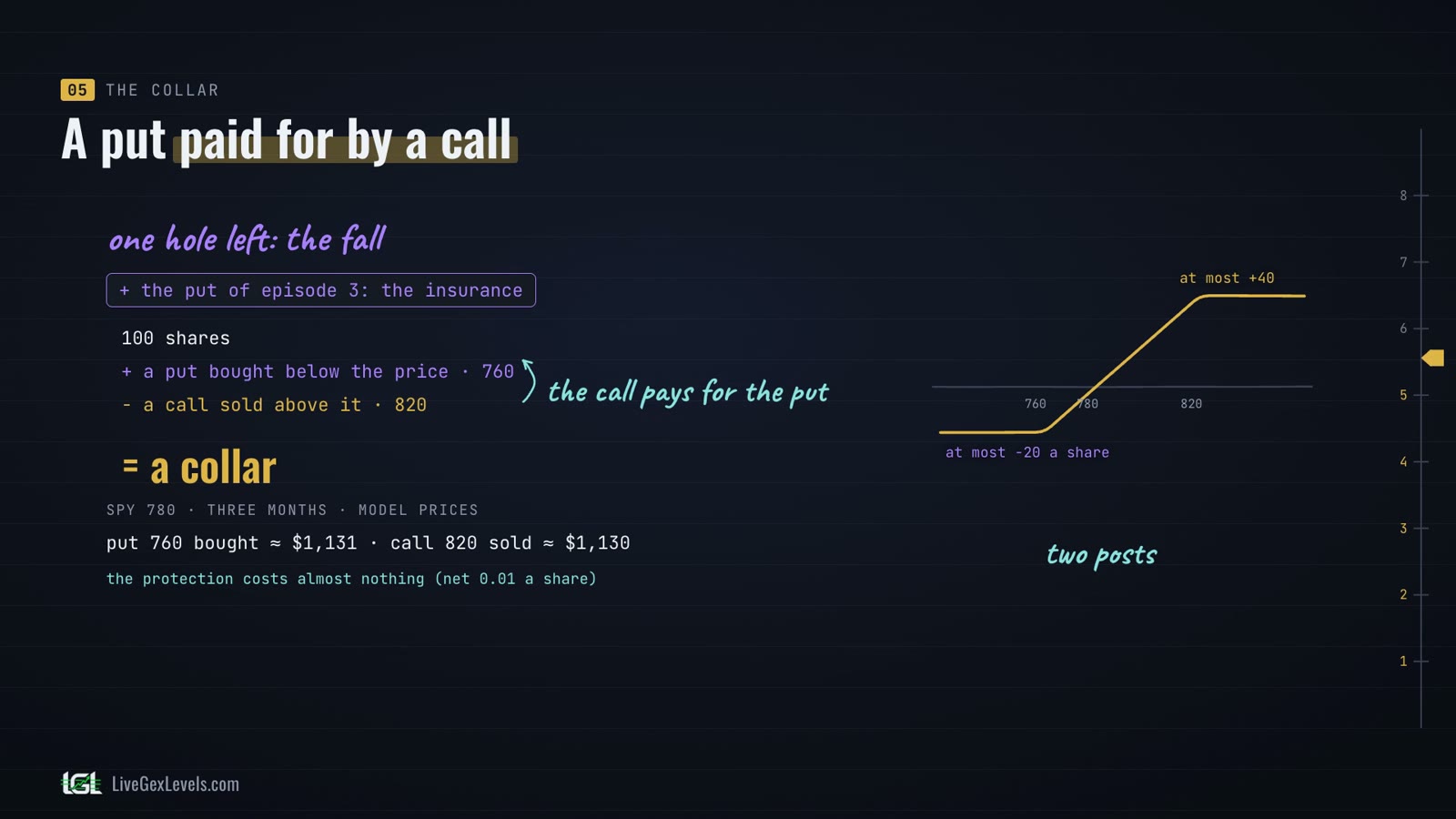
The covered call leaves one hole: the fall. To close it, you add the put from the third episode, the insurance. Shares, a put bought below the price and a call sold above it: that's a collar. The call you sell pays for the put, in part or in full.
With SPY at 780, three months out, the put at 760 and the call at 820 cost about the same in the model: around 1,130 dollars each, per contract. So you lose at most 20 dollars a share, you gain at most 40, and the protection costs almost nothing.
A famous case, as he has told it himself: Mark Cuban. In 1999 he sold his company, Broadcast.com, to Yahoo, and was paid in Yahoo shares. On those shares he bought puts and sold calls: a collar. Then the internet bubble burst. Cuban has said that without that hedge he would have lost most of his fortune.
A taste: the poor man's covered call
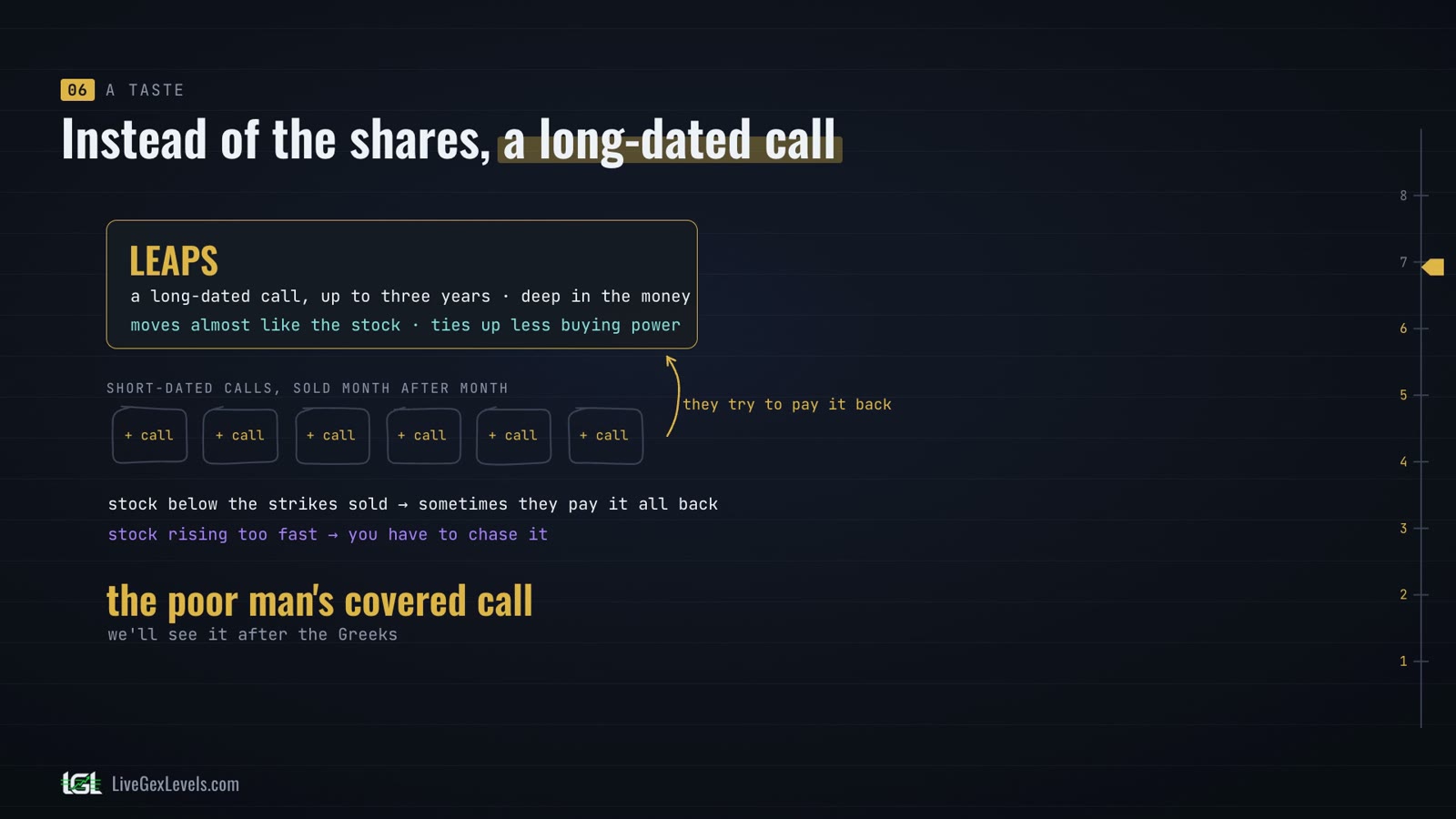
One more variant, just a taste. Instead of the shares, you can hold a LEAPS, a long-dated call, up to three years out, deep in the money: it moves almost like the stock and ties up less buying power.
Short-dated calls, sold month after month, try to pay it back: if the stock stays below the strikes sold, sometimes they pay it all back; if it rises too fast, you have to chase it. It's called the poor man's covered call, and it comes back after the greeks.
The answer
Back to the opening question. On its own, the short call is feared because its loss has no ceiling. Inside a covered call or a collar, the shares cover the obligation: the risk without limit becomes a ceiling on what you can earn. That's why investors use it so much.
The limits remain: the shares can still fall, and the gain stops at the strike.
In brief
- Selling a call means collecting the premium and taking on the obligation.
- On its own, the gain stops at the premium, and the loss, in theory, has no limit.
- With the shares underneath it's a covered call: you give up the rise above the strike in exchange for the premium.
- Add a put and it's a collar: the loss and the gain between two posts.
- Every number here comes from a model, costs aside.
Sources
More from this series
Read next
See the levels live
Seeing where dealers have to hedge is information a chart alone doesn't give you. Your edge starts with preparation.
Card required; after the trial the subscription renews at the launch price. For educational purposes only, not financial advice.