Options School · Published
What are options? From a farmer's put to the S&P 500
Spring: the wheat goes into the ground, and by autumn its price could double or halve. How do you protect yourself from the fall without giving up the rise? With a right to sell that carries no obligation: a put.
 Watch on YouTube · 9:23
In the farmer's shoes
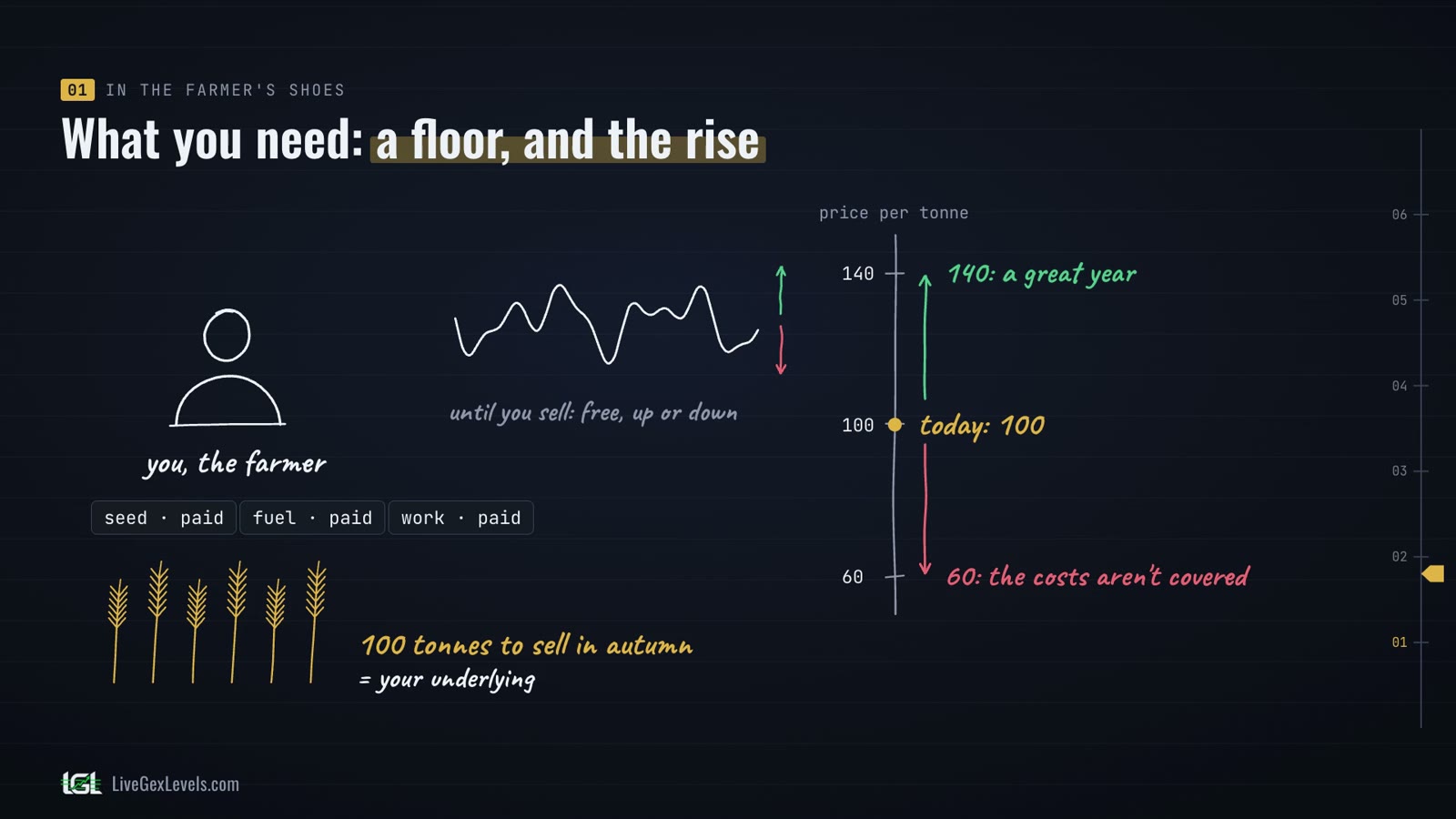
Put yourself in the farmer's shoes. The seed, the fuel and the work are already paid for, and in autumn you'll have a hundred tonnes of wheat to sell. That wheat is your underlying: until you sell it, its price moves freely, up or down.
Today wheat is worth 100 a tonne. If by autumn it falls to 60, you can't even cover your costs; if it climbs to 140, it's a great year. So what you need is simple: a minimum price, in case it falls, and the rise, if it comes.
Fixing the price: the forward
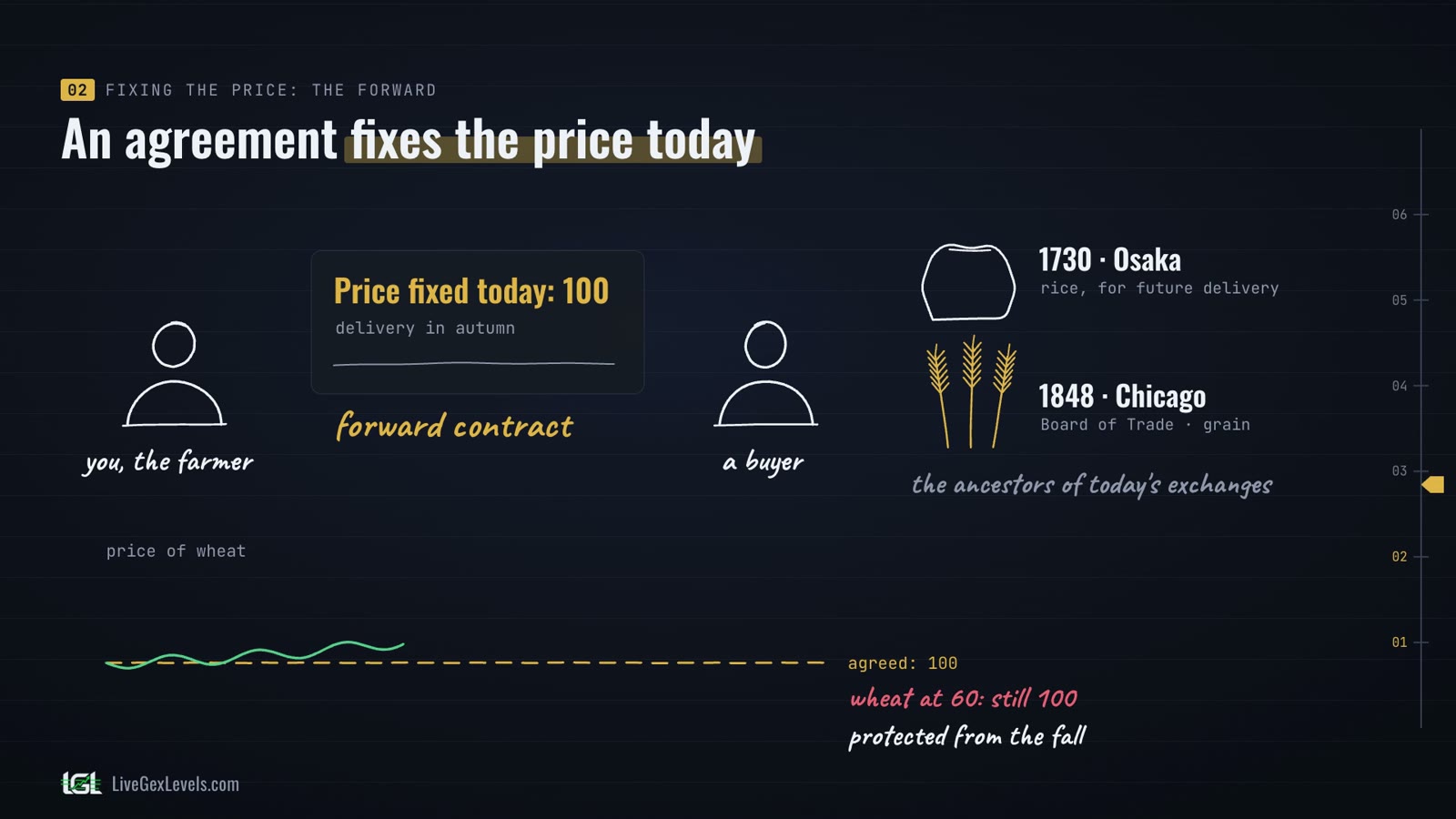
The oldest answer is an agreement. You find a buyer and fix the price today, say 100, for delivery in autumn. It's called a forward contract.
The idea has a long history. In Osaka, in 1730, the shogun authorised a market in rice for future delivery, the ancestor of today's futures exchanges. Chicago's Board of Trade, founded in 1848, did the same with grain.
If wheat falls to 60, the buyer still has to pay you 100: the forward protects you from the fall. But it cuts both ways. If wheat goes to 140, you still have to sell at 100. You've given up the rise, and both sides are bound.
The put: a right to sell
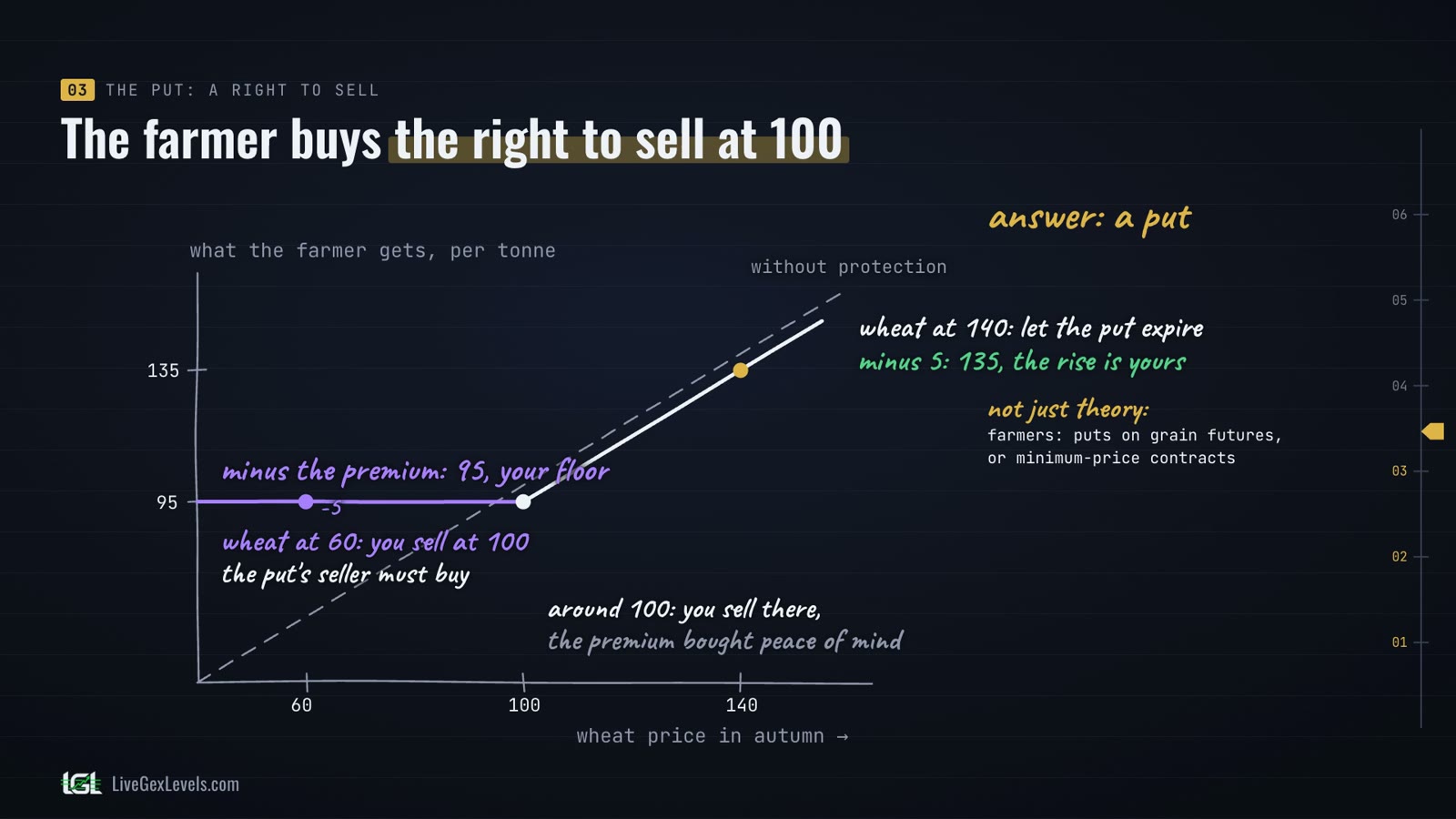
An option adds just one thing: a right, without the obligation. Here the farmer buys a put. You keep your wheat, with its price free to move, and add the right to sell the harvest at 100 by autumn. That 100 is the strike.
The right isn't free: today you pay a premium, say 5 a tonne. Now it's autumn. If wheat has crashed to 60, you use your right and sell at 100, and whoever sold you the put has to buy at that price. Net of the premium you get 95: that's your floor, the minimum price you needed.
If wheat has climbed to 140, nothing forces you to sell at 100, as the forward did. You let the put expire and sell on the market at 140: minus the premium, 135. The rise is yours. And if wheat is still around 100, you sell there, and the premium was the price of sleeping well.
It isn't just theory. Some farmers do it today, especially the larger ones, with puts on grain futures, or with minimum-price contracts that work in a similar way. Big funds do the same with puts on the S&P 500.
But who sells the farmer this right? There must be someone on the other side, a counterparty: a wheat buyer, a merchant, a speculator. They collect the premium and in exchange take on the obligation to buy at 100 if, in autumn, the price is below 100. If it isn't, they keep the premium and buy nothing: that's their pay for the risk.
And if wheat crashes to 60, who guarantees they'll really pay 100? Today it's the exchange's clearing house. It stands between buyer and seller, and asks the seller for a deposit, the margin, so the promise is kept.
One detail many people miss: a put protects the price, not the quantity. If hail destroys the crop, the put won't pay you back for what you lost; for that there's crop insurance. That other risk, the bad harvest, is exactly what a law of Hammurabi covered nearly four thousand years ago: if a storm or a drought destroyed the crop, the farmer could skip that year's loan payment.
From the harvest to the S&P 500
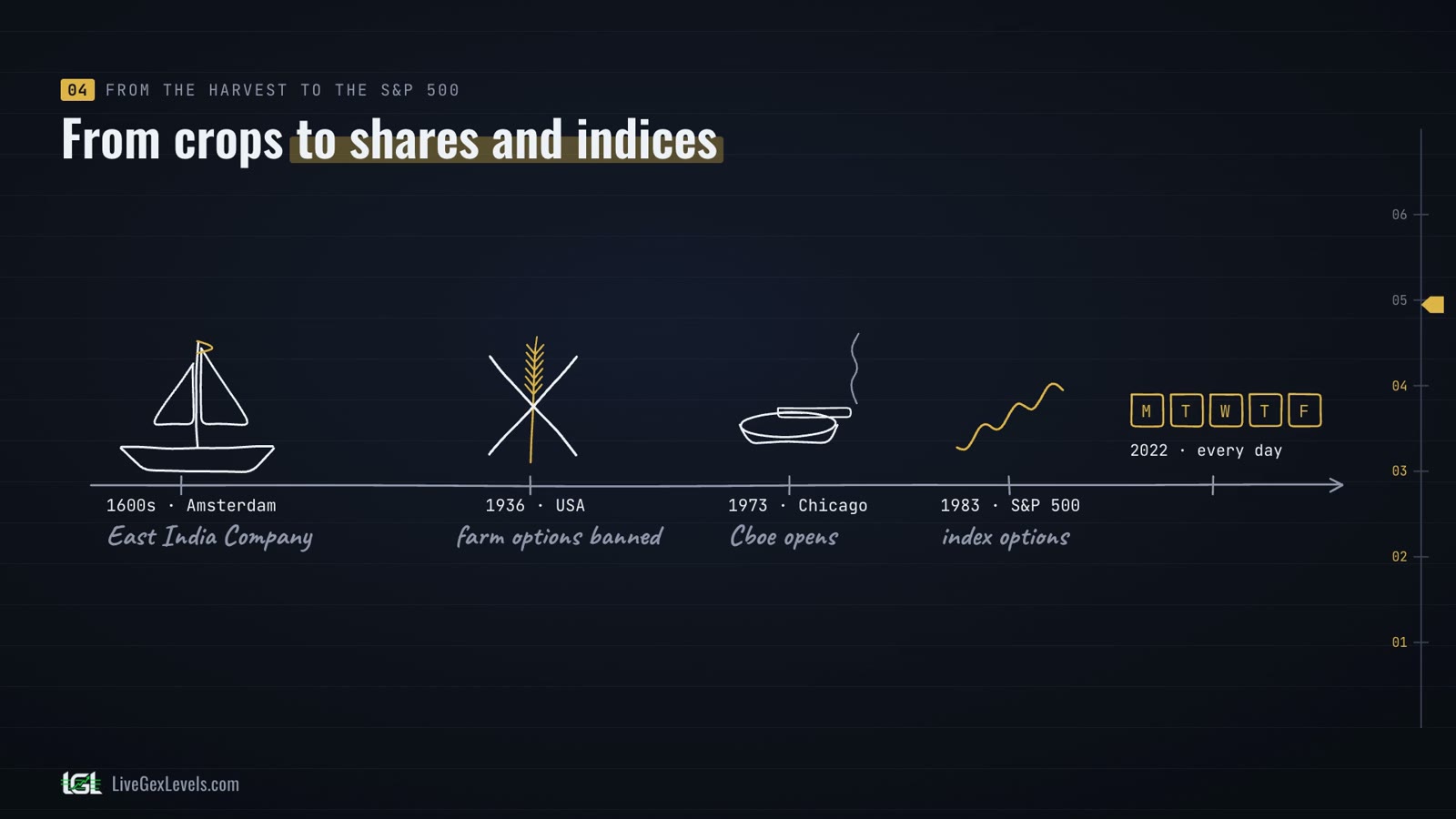
Paying a little today for a right tomorrow is a very old idea too. Aristotle tells of Thales of Miletus, who expected a great olive harvest. Thales paid a small deposit for the right to use the olive presses and, when the harvest came, rented them out at whatever price he liked. It was a bet, not protection: calling it an option is our modern reading.
From crops, options moved on to shares. In Amsterdam, in the sixteen hundreds, traders were already dealing in options on the Dutch East India Company. Then came a twist: in 1936 the United States banned options on farm products as pure speculation. A tool that could protect farmers stayed banned on their own crops until 1982.
A detail few people know: the modern market opened in Chicago on 26 April 1973, in the former smoking lounge of the Board of Trade. On day one, 911 contracts changed hands: calls only, the right to buy, on 16 stocks.
Options on the S&P 500 followed in 1983. And since 2022 there's an expiry every trading day: the 0DTE, options with zero days to expiry.
Four words
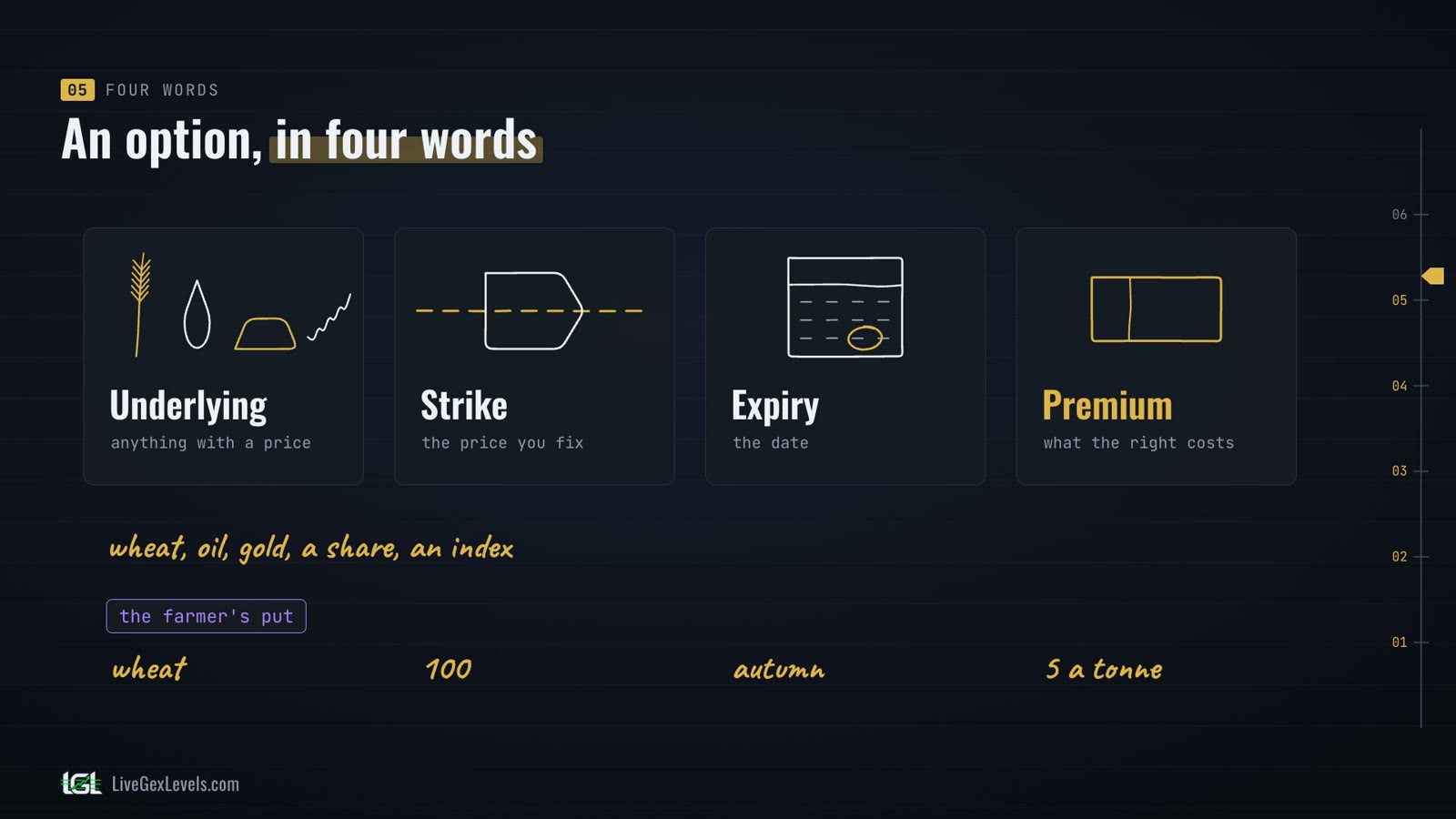
So, what did the farmer buy? An option, and every option comes down to four words. The underlying: anything with a price, wheat, oil, gold, a share, an index. The strike: the price that's fixed. The expiry: the date. And the premium: what the right costs. For the farmer, that's wheat, 100, autumn, and 5 a tonne.
There are two kinds. The farmer's is a put, the right to sell at the strike. A call is the opposite, the right to buy. Whoever buys an option holds the right; whoever sells it collects the premium and takes on the obligation, and the clearing house stands in between.
Options on the S&P 500 index, the SPX, are European and settled in cash. They're exercised only at expiry, and nobody delivers five hundred companies: just the difference between the strike and the index, in money. Options on SPY and on the futures follow other rules.
Two things to keep in mind. Protection has a price: if at expiry the price is above the strike, the premium is gone, like insurance on a house that never burns. And the premium tells you something: how far the market thinks the price could travel by expiry. Not where it will go, but how far it could go. That's called volatility, and the series comes back to it.
In brief
- The farmer needs a minimum price, without giving up the rise.
- A forward fixes the price for both sides, but the farmer gives up the rise.
- A put gives the right to sell at the strike, for a premium: a floor below and the rise kept, like insurance.
- On the other side, someone collects the premium and takes the obligation, and the clearing house guarantees both.
- On the S&P 500 that someone is usually a dealer, who covers the risk by buying or selling the underlying: that's hedging. LiveGexLevels estimates where that hedging piles up during the session.
Sources
More from this series
Read next
See the levels live
Seeing where dealers have to hedge is information a chart alone doesn't give you. Your edge starts with preparation.
Card required; after the trial the subscription renews at the launch price. For educational purposes only, not financial advice.